





Abaad Studies & Research Center Publishes Three Strategic Reports on Yemen’s War and Regional Security Threats in October
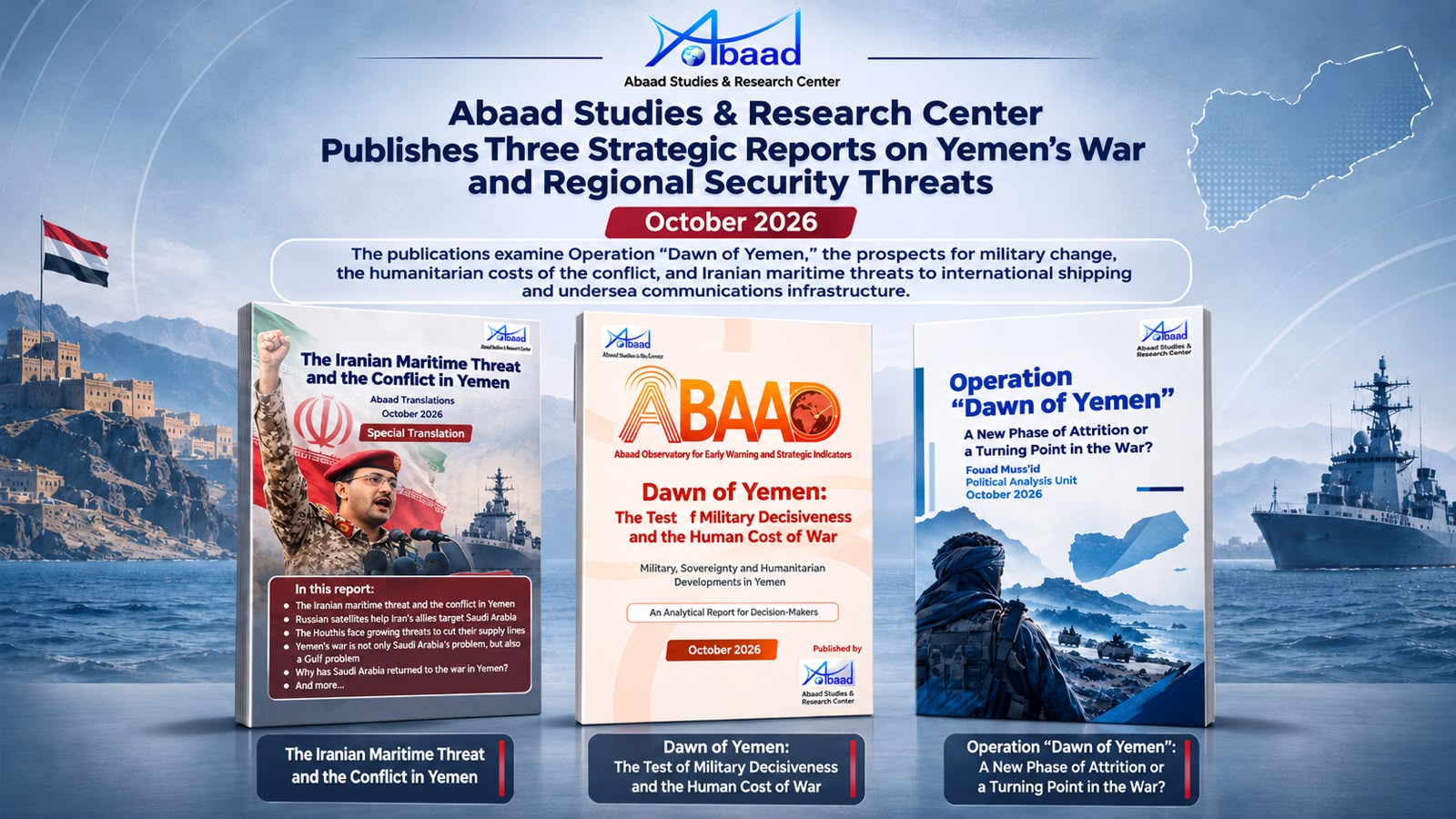
Abaad Studies & Research Center released three research and analytical publications in October 2026, examining major military and political developments in Yemen, the strategic implications of Operation “Dawn of Yemen,” and the growing regional security challenges affecting the Red Sea and international maritime trade.
The publications comprise a political situation assessment, a monthly strategic risk report by the Abaad Observatory for Early Warning and Strategic Indicators, and a collection of translated analyses addressing Iranian maritime threats and the conflict in Yemen.
The reports were released against the backdrop of significant developments in Yemen’s war, including the launch of a large-scale military offensive, escalating cross-border attacks, mounting threats to strategic waterways, and a deteriorating humanitarian situation.
Operation “Dawn of Yemen”: A New Phase of Attrition or a Turning Point in the War?
The first publication, titled “Operation ‘Dawn of Yemen’: A New Phase of Attrition or a Turning Point in the War?”, is a political situation assessment authored by researcher Fouad Massad of Abaad’s Political Analysis Unit.
The study examines the strategic significance of the military offensive announced by Yemen’s internationally recognized leadership in early October, focusing on its political and military objectives and the developments that preceded its launch.
It analyzes the changing battlefield dynamics along Yemen’s western coast and around the Bab al-Mandab Strait, as well as in Taiz, Marib, and Al-Jawf.
The assessment describes the operation as an attempt to break years of military stalemate, shift government forces from a defensive to an offensive posture, and regain the initiative in determining the timing and location of military engagements.
The study argues that the offensive carries implications extending beyond Yemen’s borders because of its connection to the security of Bab al-Mandab, one of the world’s most strategically important maritime chokepoints.
It also examines the military and political strengths and vulnerabilities of both government forces and the Houthis, identifies potential obstacles to achieving the offensive’s objectives, and outlines possible scenarios for the next phase of the conflict.
Abaad Observatory Warns of Critical Risks as Yemen’s War Enters a New Phase
In its October monthly assessment, the Abaad Observatory for Early Warning and Strategic Indicators published a report titled “Dawn of Yemen: Testing Military Decisiveness and the Humanitarian Cost of War.”
The report provides an assessment of military, sovereignty-related, and humanitarian developments, alongside an evaluation of emerging security risks and possible future scenarios.
According to the Observatory, October marked a significant turning point in Yemen’s conflict, with military operations expanding across several fronts while Houthi attacks on airports, civilian infrastructure, and targets inside Saudi Arabia intensified.
The Observatory classified Yemen’s overall risk level as “Red/Critical,” citing the convergence of military escalation, cross-border threats, internal security vulnerabilities, economic pressures, and worsening humanitarian conditions.
The report warns that a prolonged military campaign could develop into another war of attrition, particularly if battlefield gains are not accompanied by effective institutional recovery and improvements in governance and public services.
It also highlights the deteriorating humanitarian situation in Taiz, where restrictions on roads and essential supplies have increased pressure on healthcare facilities, basic services, and civilian populations.
The Observatory emphasizes that the success of military operations should not be measured solely by the number of strikes conducted or territories recaptured, but by the government's ability to consolidate territorial gains, restore state institutions, protect civilians, and resume essential services.
Among its recommendations, the report calls for integrating military operations with institutional recovery plans, developing a comprehensive Yemeni strategy for Bab al-Mandab security, strengthening protection for airports and critical infrastructure, and prioritizing humanitarian access to Taiz.
Iranian Maritime Threats and the Conflict in Yemen
The third publication, issued under the “Abaad Translations” series, is titled “The Iranian Maritime Threat and the Conflict in Yemen.”
The collection brings together translated analyses examining Iranian military escalation, maritime security threats, the security implications of the Yemen conflict for Saudi Arabia and other Gulf states, and the potential consequences for regional and international stability.
A central theme is the emerging threat to undersea telecommunications cables and digital infrastructure in the Red Sea and the Strait of Hormuz.
One analysis, authored by Can Kasapoğlu, examines the potential consequences of Iranian and Houthi threats against submarine communications cables, warning that disruptions could affect global internet connectivity, financial transactions, cloud computing, and international commerce.
The analysis stresses, however, that some of the capabilities attributed to Iran and the Houthis remain unproven, distinguishing potential threats from demonstrated operational capabilities.
The publication also explores the strategic importance of Houthi supply routes, the factors behind Saudi Arabia’s renewed military involvement in Yemen, the broader implications of the conflict for Gulf security, and the possibility of further regional escalation.
Together, the translated articles underscore the increasingly interconnected nature of the conflict in Yemen and regional security dynamics, particularly as the Red Sea and Bab al-Mandab become central to wider geopolitical competition.
Research and Strategic Analysis to Support Decision-Making
The three October publications reflect Abaad Studies & Research Center’s continuing focus on analyzing Yemen’s evolving conflict through political and military assessments, early warning indicators, strategic risk monitoring, and international research.
Although the publications approach developments from different perspectives, they converge on a central conclusion: Yemen’s military trajectory cannot be separated from the security of the Red Sea and the Gulf, or from the ability of state institutions to manage the consequences of war and mitigate its humanitarian and economic costs.
Through its research, strategic assessments, and translated publications, Abaad seeks to provide policymakers, researchers, and international stakeholders with evidence-based analysis of Yemen’s conflict, emerging regional threats, and the prospects for restoring state institutions and achieving lasting security and stability.