





New Yemeni Government: Challenges and Opportunities
Introduction
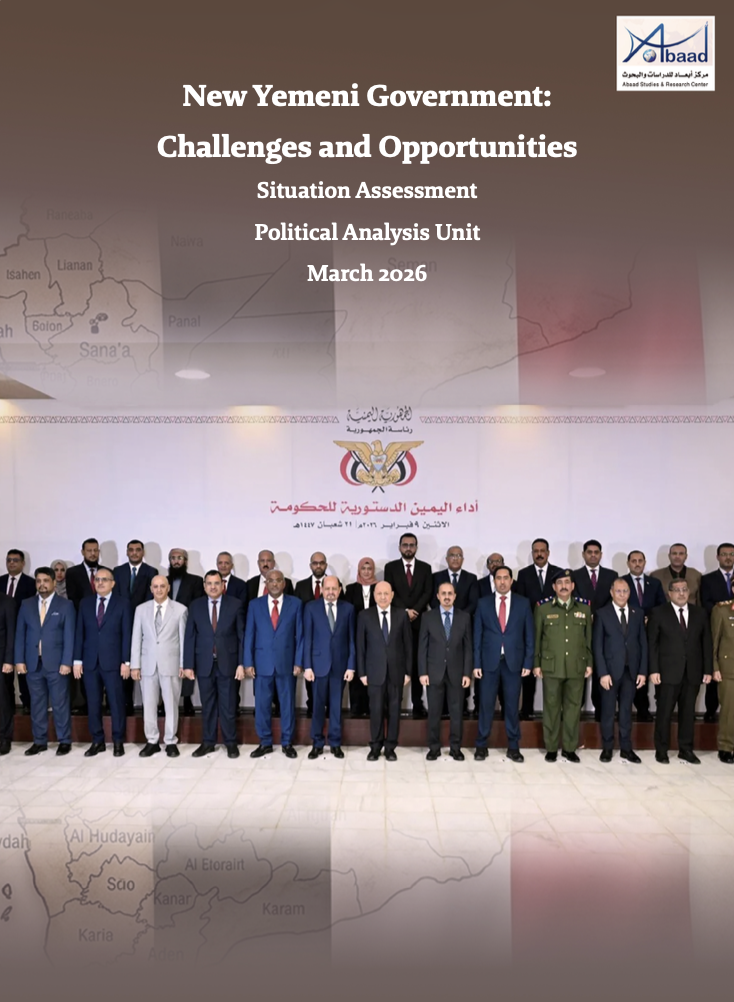
The formation of Yemen's new government led by Prime Minister Dr. Shaya Al-Zandani marks a pivotal moment in the country’s political, economic and security trajectory. More than a routine cabinet reshuffle, it represents a critical test of the executive authority’s capacity to restore a coherent center of decision-making under exceptional domestic and regional circumstances.
The stakes have risen sharply following the collapse and formal dissolution of the Southern Transitional Council (STC). That development has left a political and security vacuum across several government-controlled governorates, most notably in the interim capital, Aden. Meanwhile, actors affiliated with the former STC continue to test the resilience of the new administration — at times mobilizing street protests, at others invoking the southern cause as a lever of political pressure.
Against this backdrop, the government faces a multidimensional challenge: reasserting state authority, stabilizing a fractured security environment, reviving a deeply strained economy, and rebuilding public trust — all while carefully managing sensitive political and social balances. Complicating the equation is the role of Saudi Arabia, whose support could function as a strategic enabler if effectively leveraged.
Political Challenges
The Post–STC Landscape
Since its establishment in 2017, the STC positioned itself as a dominant political and security force in Yemen’s south. Its influence was underwritten by Emirati support, including the creation and financing of parallel military and security formations operating beyond the institutional authority of the Ministries of Defense and Interior.
Although Riyadh brokered an agreement between the government and the STC in 2019, the arrangement proved fragile. Over time, the Council distanced itself from its commitments, consolidating its influence and entrenching control across much of the south.
With the STC’s military and political structures now dismantled, the government enters a delicate transitional phase. The challenge is not merely to manage the fallout from the Council’s dissolution, but to prevent the reconfiguration of its networks into new informal power centers. Former affiliates are unlikely to withdraw from the political arena. More plausibly, they will adapt — operating through localized actors or influence networks within an increasingly fluid political environment. Such conditions create opportunities for obstruction and destabilization, as evidenced by recent mobilization efforts culminating in an attempted storming of the presidential palace complex in Ma’ashiq, Aden
The Question of Internal Legitimacy
While the government derives formal authority from constitutional legitimacy and international recognition, its credibility at home will ultimately depend on performance.
In recent years, governance in Aden and other government-controlled areas has been characterized by a pattern of dual authority. Decision-making was frequently divided between formal state institutions and armed formations not fully integrated into the national chain of command. The dual role of Aidarous Al-Zubaidi — as both a member of the Presidential Leadership Council and head of the STC — embodied this structural ambiguity, often exacerbating divisions within the internationally recognized camp itself.
The new government must therefore move beyond symbolic authority and re-establish a unified state presence in security administration, service delivery, and resource management. Failure to do so would risk reviving narratives that question the viability of centralized governance, potentially reopening the door to fragmented authority and the re-emergence of parallel military and security structures.
Security Challenges
1. Dismantling Parallel Structures
Perhaps the most urgent task is addressing the legacy of fragmented armed formations that emerged during the war. Years of conflict produced a patchwork security landscape in which various actors — some locally rooted, others externally backed — operated with overlapping mandates and competing loyalties.
Comparative post-conflict experiences, notably in Iraq and Libya, underscore the dangers of allowing parallel security structures to persist. Where reform is delayed or superficial, the result is often a “state within a state,” in which armed networks become entrenched obstacles to stabilization.
A credible security sector reform strategy will therefore require gradual but decisive steps, including:
- Dismantling and integrating parallel military and security formations into formal institutions on the basis of clear operational and professional criteria — rather than cosmetic rebranding.
- Establishing unified command structures that ensure all forces operate under the Ministries of Defense and Interior. Current conditions may offer a favorable opportunity for such consolidation, particularly given Saudi support and broader regional and international alignment — with the notable exception of the UAE, which was expelled from Yemen in late December.
- Reinforcing the state’s exclusive monopoly over the legitimate use of force.
- Standardizing salaries and compensation systems to strengthen professionalism and reduce administrative distortions to enhance the conditions of military and security personnel.
2. Aden as a Strategic Litmus Test
Aden stands at the center of this transition. As the interim capital, Yemen’s most strategic port, and a symbol of constitutional legitimacy in contrast to Houthi-controlled Sana’a and other governorates, Aden’s stability carries national significance.
Yet Aden has endured years of volatility, including targeted assassinations, factional rivalries, and recurring institutional paralysis. These dynamics were intensified by Emirati policies that relied on the STC to advance strategic interests, particularly in securing influence over ports and islands. In the process, local political and social actors who opposed that trajectory were often marginalized.
The continued presence of former STC-supporters seeking to provoke unrest or obstruct state institutions compels the government to adopt a dual-track approach: firm security measures against any breach of law and order, coupled with an inclusive and confidence-building political strategy toward local constituencies that fear marginalization.
For the new government, Aden is more than a geographic capital; it is the proving ground for state restoration. Success in stabilizing and governing the city effectively would send a powerful signal domestically and internationally that centralized authority can be rebuilt.
Economic Challenges
1. Currency Instability and Public Finance
Yemen’s economy continues to experience severe deterioration, reflected in widening fiscal deficits, declining public revenues, and a prolonged currency crisis. The situation has worsened further following Houthi attacks on oil export facilities in Hadramout and Shabwa, which have significantly disrupted one of the government’s primary sources of income.
Under these circumstances, the government faces a set of urgent economic priorities. Chief among them are restoring oil and gas exports, combating corruption and financial fragmentation within state institutions, and curbing the entrenched war economy that has expanded during the years of conflict[1].
Stabilizing the national currency also requires strengthening the capacity of the Central Bank in Aden. This will necessitate both technical assistance and financial backing, as currency stabilization cannot realistically be achieved without substantial external support — most importantly from Saudi Arabia.
2. Saudi Support as a Strategic Lever
Saudi Arabia has played a central role in sustaining the Yemeni government over the past years, particularly through financial deposits to the Central Bank and fuel assistance aimed at supporting electricity generation and public services.
Given the current regional context, Saudi support could prove decisive for the government’s ability to navigate the coming phase. However, the effectiveness of this assistance will depend largely on how it is utilized. Directing financial support toward productive sectors and revenue-generating projects — rather than relying solely on consumption-based spending — will be essential.
Equally important is linking external assistance to meaningful fiscal and administrative reforms, alongside strengthening transparency in the management of grants and financial support.
If managed effectively, Saudi support could enhance public confidence in the government while providing it with greater room to maneuver politically and in the security sphere.
Public Services and the Restoration of State Authority
Public services —particularly electricity, water, healthcare, and education — remain the most immediate indicators by which citizens evaluate government performance.
In Aden, repeated electricity crises, especially during the summer months, have fuelled widespread public frustration. At the same time, the deterioration of healthcare and education services threatens the long-term erosion of Yemen’s human capital.
Achieving tangible improvements in service delivery would therefore have implications that extend beyond daily life. It would contribute directly to strengthening stability and restoring public confidence in state institutions after years of governance failures that led to the collapse of essential services.
Every measurable improvement in public services generates political capital for the government and reduces the likelihood that public discontent will translate into mobilization around calls for unrest.
The Social Dimension
The social dimension of the new government’s challenges is no less significant than the political and security ones. Rebuilding the Yemeni state ultimately requires rebuilding trust within society and redefining citizenship on the basis of equality and equal rights.
If the government succeeds in translating its inclusive political discourse into fair and transparent policies, it could lay the foundations for a new phase in which competing identities gradually give way to a broader national identity rooted in the rule of law and institutional governance.
The war has profoundly reshaped Yemen’s social structure. It has widened socioeconomic disparities, deepened class divisions, and fostered an economy heavily dependent on humanitarian assistance and remittances. At the same time, political and regional polarization has further intensified social fractures across the country.
These conditions place an additional responsibility on the government to promote a unifying national discourse that redefines citizenship around equal rights and shared national belonging, rather than regional, factional, or political alignments.
Setting Priorities
The government’s prospects for success will depend largely on its ability to present a clear, priority-driven program of action. Such a program should focus on strengthening public revenue collection, consolidating security in Aden and other government-controlled areas, improving public services, and ensuring the regular payment of public sector salaries.
To reinforce its domestic legitimacy, the government must also broaden its support base by engaging political and social actors across the governorates under its authority and by opening structured channels of communication with southern political elites.
While Saudi support remains essential, it cannot substitute for necessary internal reforms. Rather, it should serve as a catalyst for them. The more convincingly the government demonstrates its commitment to combating corruption and restoring stability, the greater the likelihood that external support, particularly from Saudi Arabia, will be sustained and expanded.
Refocusing Efforts on State Restoration and Ending the Houthi Coup
If the internal conflicts that dominated previous years were driven largely by the Emirati agenda and its local instrument, the Southern Transitional Council, the government now faces the task of redirecting national efforts toward a broader strategic objective shared by most Yemenis: restoring the state and ending the Houthi coup.
Achieving this goal requires learning from the lessons of the past decade and capitalizing on every available opportunity to advance the liberation of governorates that remain under Houthi control.
In this context, the unification of Yemen’s fragmented military and security formations represents a critical step. Consolidating these forces under a unified command structure would mark an important turning point in rebuilding coherent state authority.
Conclusion
The new government stands before a historic test. The central question is whether it can transform the current moment of political fluidity into an opportunity to rebuild state institutions in the governorates under its control.
The challenges it faces are deeply interconnected, political, security, economic, and social, and cannot be addressed in isolation. Nevertheless, a clear reform-oriented vision, supported by meaningful Saudi backing and underpinned by firm political will to enforce security and combat corruption, could provide the government with a genuine opportunity to achieve gradual but meaningful progress.
Such progress would help restore public confidence in state institutions and lay the foundations for sustainable stability in Aden and across Yemen’s government-controlled governorates.
[1] Aba'ad published analytical paper in mid-November regarding the issue, the paper can be accessed at this link: :
https://abaadstudies.org/strategies/topic/60172 .