





What Lies Behind Iran’s Test of New Rules of Engagement in Yemen?
Introduction
The landing of an Iranian aircraft at Sana’a International Airport on July 3, 2026, and its subsequent departure carrying a delegation from the Houthi leadership to Tehran, represents a critical turning point that goes beyond what was publicly presented as a civilian flight. It constitutes a multi-layered political, sovereignty-related, and security test through which the Houthi group and its Iranian ally seek to impose new rules of engagement with Saudi Arabia and the wider region. The Houthis regarded the flight as a “breaking of the blockade” and a practical step toward the continuation of Sana’a-Tehran flights. By contrast, the internationally recognized Yemeni government treated it as a direct violation of Yemeni sovereignty and a challenge to UN Security Council resolutions, linking the flight to the possible transfer of military experts and dual-use equipment. Saudi Arabia, for its part, neither confirmed nor denied the Houthi account regarding an attempted aerial prevention, but later responded with a strongly deterrent tone, threatening the use of “unprecedented force” against any targeting of the Kingdom or violation of Yemen’s sovereignty.
The event came after weeks of intense internal Houthi mobilization that linked the economic crisis, salary issue, sovereignty over ports and airports, and regional shifts connected to Iran and the Red Sea.
Subsequent developments reveal that Sana’a and Tehran are attempting to establish a new precedent and alter the rules of engagement that have existed since 2015, rather than merely showing a strongly deterrent tone. The public reappearance of the Iranian ambassador to the Houthis in Sana’a, the presence of a senior Houthi intelligence official in the delegation traveling to Tehran, and meetings between Houthi leaders and Iranian officials all indicate that the Sana’a-Tehran air route carries political, security, and military dimensions, and is far from being limited to humanitarian considerations.
Strategic Background
The July 3, 2026 flight derives its strategic significance from its position within the Yemeni-Saudi-Iranian triangle. Yemen represents a vital security and geopolitical depth for the Kingdom of Saudi Arabia, while Tehran has used it as a low-cost arena to drain its rivals and threaten navigation near Bab al-Mandab. According to UN reports, this has contributed to the transformation of the Houthi group from a limited local actor into an advanced military organization with regional impact, supported directly by Iran and its allies.
Although the China-brokered Saudi-Iranian rapprochement in March 2023 created an opportunity for de-escalation and produced a UN roadmap that included economic and humanitarian understandings, the process collided with broader regional and international balances. Since late 2023, the Houthis’ involvement in targeting international shipping in the Red Sea under the banners of regional “support” and the “unity of fronts” has internationalized the Yemen crisis, shifting it from a containable local conflict into a global strategic node directly linked to energy security and the movement of international trade.
The April 2022 truce provided for humanitarian commercial flights from Sana’a Airport to Amman and Cairo. While flights to Jordan continued, Egypt refused to recognize passports issued in Houthi-controlled areas. This file quickly became a field of confrontation, reaching a peak in June 2024 when the group held four Yemenia aircraft immediately after they returned from transporting pilgrims. Those planes were later exposed to Israeli airstrikes in May 2025 that destroyed them, along with most of the main airport and its runways. The Yemeni government then took a decisive decision to prevent the return or landing of the remaining national fleet aircraft at Sana’a Airport, in order to protect them from detention or military targeting. This eventually led to the complete suspension of civil and commercial aviation at the airport.
The Breach and Its Consequences
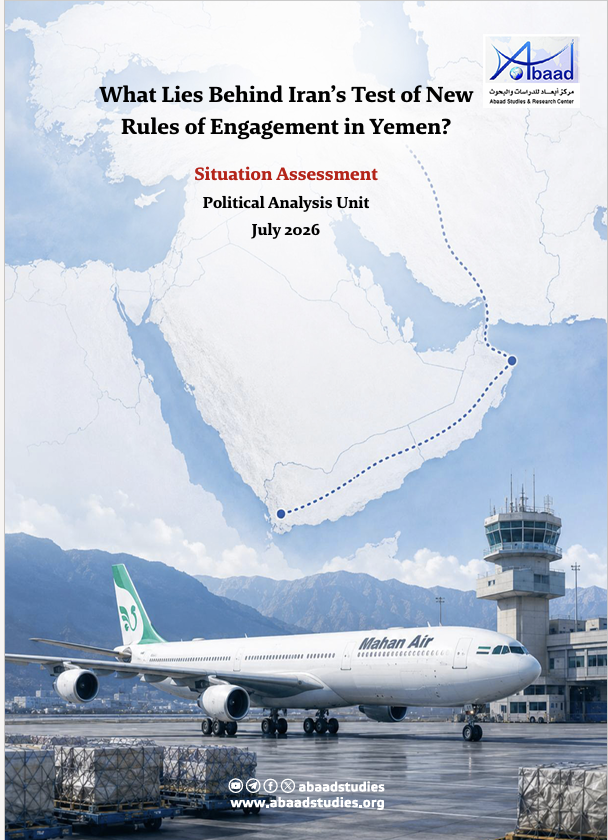
Flight-tracking data for the Mahan Air flight (W51199) revealed exceptional operational planning. A wide-body Airbus A340-300, with large capacity for both cargo and passengers, was used in a manner that exceeded the normal constraints of light UN flights. To secure the passage of the U.S.-sanctioned aircraft, the flight took a long detour of roughly 3,200 kilometers along Omani airspace, avoiding potential areas of military confrontation in the Gulf and the Arabian Sea. This suggests the existence of tacit regional understandings and logistical arrangements that provided safe passage for the aircraft, amid suspicions that experts and sensitive qualitative weapons, such as biological-related materials, may have been transported. [1]
The Iranian aircraft’s flight did not pass without direct military friction. A silent aerial confrontation occurred over Amran and Sana’a at dawn on July 3. [2]As the Iranian aircraft approached the capital’s airspace between 4:00 and 5:00 a.m. local time, fighter jets belonging to the Royal Saudi Air Force attempted to intercept the aircraft and prevent it from landing at the airport, in implementation of established ban measures. The Houthis launched interception missiles, while the fighter jets carried out strikes against the sources of fire. The Houthis confirmed the first military engagement since 2022, and Riyadh did not deny that it occurred. The aircraft landed with more than 200 passengers onboard and loaded more than 200 others on the return flight.
After the incident and the aircraft’s arrival in Tehran, the Houthi military spokesman, Brigadier General Yahya Saree, quickly delivered a televised statement carrying direct and unprecedented threats against Saudi Arabia and affirming the continuation of flights between Sana’a and Tehran “regardless of the consequences and repercussions.” [3]The statement articulated the Houthis’ vision of a new deterrence equation they are trying to impose, based on a “comprehensive and direct response”: any future attempt to target aircraft heading to Sana’a Airport would be met with a comprehensive response against the Kingdom’s airports and vital interests on land and at sea. The announced target bank included critical infrastructure, such as the main international airports in Riyadh and Jeddah, Aramco facilities, and ports, in addition to a direct threat to the investment environment and the Saudi stock market, Tadawul, in an attempt to link regional economic stability to the lifting of aviation and economic restrictions on the group. [4]
Saudi Arabia responded the following day through the coalition statement, describing the Houthi threats as an attempt to divert attention from the group’s violations against Yemenis, and warning of a firm response with “unprecedented force” against any targeting of the Kingdom or violation of Yemen’s sovereignty. [5]The official position of the internationally recognized Yemeni government responded swiftly and forcefully. Hours after the aircraft landed, the Presidential Leadership Council held an extraordinary emergency meeting in which it described the direct flight to Sana’a as a “blatant violation of Yemeni sovereignty” and a “challenge” to international law and Security Council resolutions, considering it a direct threat to regional and international security. [6]Three days later, President Rashad al-Alimi escalated the discourse further, calling for an international investigation into the aircraft’s cargo. He said preliminary indicators undermined the Houthi humanitarian narrative, noting that reports pointed to the presence of Iranian military and security elements, experts in drone and missile development, and communications, command-and-control equipment. He also referred to repeated interruptions in tracking signals during the aircraft’s passage through Yemeni airspace. [7]
The use of an aircraft associated with Mahan Air increases the sensitivity of the move. The U.S. Treasury designated Mahan Air in 2011 for providing material and logistical support to the Quds Force of the Islamic Revolutionary Guard Corps, stating that the company transported personnel, weapons, and funds. The Council of the European Union also listed it among sanctioned entities in 2024 because of its relationship to the transfer and supply of drones and related technologies linked to Russia and to actors undermining security in the Middle East and the Red Sea. Therefore, even if no military cargo on the July 3 flight has been publicly proven, the choice of a carrier with such a record automatically raises the political and diplomatic cost of suspicion.
The Event as a Test
The landing of the landing of the Iranian aircraft in Sana'a should be understood as a practical test of a new equation, not as an isolated event. Since late June, the Houthis have escalated a discourse based on the claim that the stage of “no war and no peace” is no longer sustainable, and that Saudi Arabia must implement what the group describes as humanitarian and economic entitlements, primarily salaries and the opening of outlets and the airport. The Iranian flight therefore provided the group with a practical model of what “extracting rights” means: not waiting for a formal understanding, but imposing a new reality and then demanding that other parties deal with it.
Politically, this discourse gives the Houthis internal and external gains. Domestically, it presents the leadership as capable of breaking isolation and forcing opponents to retreat, while remobilizing the base around the idea of symbolic victory after years of bargaining over the airport, salaries, and the roads to Taiz. Externally, it sends a message to Tehran and the “resistance” axis that the group can convert political alignment into tangible logistical infrastructure. It was therefore not a secondary detail that the flight was linked to attendance at Khamenei’s funeral, because what occurred was an act of political loyalty as much as it was a transport movement.
Nor was the choice of Iran a secondary detail. Tehran is neither a neutral airline operator nor a humanitarian mediator, but rather the regional actor that supports the Houthis and is most closely attached to the movement within the “unity of fronts.” The aircraft’s arrival in Sana’a therefore gave the event a dual function: internally, it could be marketed as the first gain of the mobilization phase; externally, it appeared as a signal that Iran is ready to move from negotiating with its neighbors over the regional situation to an overt role in enabling its Houthi allies in Yemen, away from international law, regional considerations, and international recognition.
Most importantly, the Houthis did not leave the event within its technical limits as a breach of what they call the “blockade.” Instead, they emphasized that flights between Sana’a and Tehran would continue “whatever the consequences and repercussions,” and threatened to target Saudi vital interests if the flights were prevented. In this sense, the airport became a testing ground for deterrence, just as the Red Sea became a testing ground for the Houthis’ ability to affect international navigation after the start of the Israeli war on the Gaza Strip in October 2023.
One of the striking shifts in Houthi discourse is the movement from speaking about “ending suffering” to speaking about “sovereignty.” The airport is no longer presented only as a necessary outlet for patients and stranded travelers, but as a symbol of the right of the movement to manage its airspace without permission from the Yemeni government, Saudi Arabia, the United Nations, or any external party. This shift is significant because it raises the political cost of any negotiated settlement. The dispute is no longer over the number of flights or their destinations, as it was after the April 2022 truce, but over who holds decision-making authority over the airspace under Houthi control.
This sovereign framing serves the group on several levels. It allows it to portray any Saudi objection to the flights as a continuation of what it calls the “blockade,” provides material for internal mobilization amid a severe economic and living crisis, and enables the group to remove the airport from the negotiation files by treating it as a “sovereign” matter for the movement. It would then be followed by new stages involving “sovereignty by land, sea, and air,” as the movement’s media outlets say. This empties future negotiations of technical files and strips the government of part of the value of its international recognition.
Iran’s motives appear complex. First, there is the symbolic dimension connected to Khamenei’s funeral, the mobilization of allied delegations, and the display of cohesion within the regional network even at a moment of transition or disruption at the leadership level. Second, there is the dimension of testing the limits of Saudi and international deterrence: can Tehran inaugurate a direct air presence in Sana’a without an immediate cost? Third, there is a possible practical dimension, namely turning symbolic humanitarian flights into a repeatable channel of communication. From this perspective, the mere success of the first flight is, in Iranian logic, proof of possibility more than the opening of a full air route.
Houthi Motives: Deterrence, Negotiation, and the Domestic Front
The Houthis' actions appear to be driven by three interrelated strategic considerations. The first is deterrence: the group wants to convince Saudi Arabia that the rules of 2015 are no longer valid, and that attempts to control the airport or airspace will be met with responses that are not limited to Yemeni fronts. The second is negotiation: the higher the cost of preventing flights, the more likely new arrangements over the airport, ports, and salaries become. The third is the domestic front: the group needs a tangible achievement that redirects public frustration away from the worsening economic crisis and rising tribal tension.
Since the beginning of this year, indicators of social erosion and internal crises have appeared, including the case of Sheikh Hamad bin Fadgham and the Al-Rayyan encampments, which generated a collision between the movement and “tribal sovereignty.” [8] In this climate, the “breaking the blockade” phase gives the Houthi leadership an opportunity to rebuild domestic authorization around a unifying sovereign issue and reduce focus on its inability to address poverty, salaries, and services.
However, this strategy carries the risk of blowback. If the flights are not repeated, or if the group fails to turn the event into a sustainable gain, the narrative may become a burden on it. The Houthi leadership has raised the ceiling of expectations among its audience and linked the airport to a new phase. Retreating without a clear return will weaken the effect of the achievement, while continuing escalation may open the door to a confrontation whose trajectory cannot be fully controlled.
The Iranian Presence: Greater Challenge and Higher Risks
On the sidelines of the funeral ceremonies for the former Supreme Leader in Tehran, Major General Jalal al-Rowaishan, the Houthi deputy prime minister for security affairs, held a closed bilateral meeting with Iran’s new foreign minister, Seyed Abbas Araghchi, on July 4. During the meeting, Araghchi sent decisive messages of strategic support, announcing his country’s full readiness to mobilize all its capabilities and regional and international diplomatic influence to support the Houthis and to show pressure for the lifting of the comprehensive economic and aviation blockade imposed on them. He also affirmed Tehran’s commitment to supporting peace terms conditioned on lifting restrictions on Yemeni ports and airports and consolidating Sana’a’s sovereign rights. Iranian officials, including Alaeddin Boroujerdi, a member of the National Security Committee in the Shura Council, also confirmed that Iran would take further steps to “break the blockade” on the Houthis. [9]
The public reappearance of Ali Rezaei, the Iranian ambassador to the Houthis in Sana’a, after a public absence since November 2024, is a highly significant indicator. If his arrival did indeed take place on the Iranian aircraft, Tehran is confirming that the flight carried a political, diplomatic, and security function aimed at reestablishing its political presence inside Sana’a at a moment of direct challenge to Saudi Arabia. The meeting between Rezaei and Abdulwahid Abu Ras did not come in a routine diplomatic protocol meeting, but revolved around expanding Yemeni-Iranian cooperation and breaking the blockade, accompanied by Houthi praise for Iran’s decision to send a Mahan Air flight. This means that Iran wanted to present itself as a party capable of breaking the restrictions imposed on the Houthis, not merely as a distant political ally. Here, the aircraft becomes a tool of political declaration: Tehran is present in Sana’a, Sana’a is not isolated, and any attempt to prevent this presence will be a direct test of the new regional deterrence equation.
The appearance of Hassan al-Kahlani, the Houthi intelligence official responsible for external security and relations, as part of the delegation in Tehran, reinforces the security dimension of the event. This was not the composition of an ordinary medical delegation, but a delegation that brought together political, security, media, and religious figures. This gives the flight a broader function: reconnecting political and security channels between Sana’a and Tehran, and showing that the relationship between the two parties has moved into a more public phase after recent regional developments and the sense among the Houthis and Iran that the “resistance axis” has emerged victorious from the war, and that Saudi Arabia and the Gulf states should submit to the options of the victors. The movement is keen to display Iran’s role in this event and link it to the “unity of fronts,” sending the message that any action against Sana’a will no longer be read as a local Yemeni event, but as an attack on one link in a regional axis that could summon simultaneous or gradual responses from more than one arena.
For Iran, the event provides an opportunity to show that its influence in Yemen remains capable of activation at moments of pressure. It can present itself as a party that supports “lifting the blockade” diplomatically and humanely, while at the same time making it harder to separate the two theaters: the Strait of Hormuz and Bab al-Mandab. For the Houthis, overt Iranian presence strengthens their negotiating position, but it also increases the likelihood that Saudi Arabia and the United States will view the airport as part of an Iranian “resistance axis” regional network, rather than merely a civilian facility.
Facing Escalation
Riyadh faces a complex challenge in responding to Houthi escalation. Allowing the repetition of flights between Sana’a and Tehran may be read by the Houthis and Iran as practical recognition that the rules of engagement have changed. Preventing them by force, however, may give the Houthis a pretext for military or maritime escalation, something the Kingdom does not want under current conditions.
The coalition statement attempted to officially return to the language of direct deterrence, using clear threats. Its reference to responding “firmly” and with “unprecedented force” reflects that Saudi Arabia is not treating the event as a dispute over an air flight, but as a Houthi-Iranian attempt to penetrate the rules of de-escalation and redefine air sovereignty in Yemen. Yet the subsequent Houthi response did not retreat. Instead, it escalated further by hinting at “catastrophic consequences for the global economy,” [10] an unmistakable reference to Bab al-Mandab and international navigation. The movement also exploited the statement to reinforce its narrative that Riyadh is not a “mediator” but the “head of the aggression,” and that it has no right to determine whether operating the airport is legitimate or illegitimate. [11]
The greatest danger lies not in the flight itself, but in the possibility that it becomes an operational precedent. If Sana’a-Tehran flights turn into a semi-regular channel, this would give Iran a direct logistical outlet on the southern Red Sea coast, not far from Bab al-Mandab, and would make it harder to separate the Hormuz/Gulf theater from the Red Sea/Bab al-Mandab theater. This dilemma is reinforced by developments that coincided with the Iranian aircraft incident at Sana’a Airport: navigation risks in Hormuz rose to a “severe” level after attacks on tankers, while Saudi Arabia began discussions on expanding the capacity of the East-West pipeline to the Red Sea in order to reduce dependence on Hormuz. [12]Linking the two corridors means that any Yemeni-Saudi-Iranian escalation will not remain purely Yemeni.
Hodeida and Bab al-Mandab: The Next Pressure Theater
On July 4, the Houthis launched one of their fiercest attacks on positions held by forces loyal to the Yemeni government, the first attack of such intensity since the 2022 truce. The confrontations reportedly killed 16 government soldiers and wounded 22 others, according to medical sources in hospitals near the fighting areas. A Yemeni minister stated that more than 50 Houthi fighters were killed during the clashes. [13]
These clashes cannot be separated from the context of the Iranian aircraft. The Houthi attack on the Hays front, specifically in the Jabal Dabbas area, came at a moment of broader political and military escalation. The significance of this front lies in its connection to the western coast and the Red Sea. Control of elevated positions around Hays gives the Houthis pressure and surveillance capabilities toward Al-Khawkhah and the coast.
Available indicators suggest that the attack was not a spontaneous clash. It used tactics that included snipers, drones, and mortars, while residents reported additional mobilization toward the nearby Al-Jarrahi district. [14] If these mobilizations continue, Hodeida may become a parallel land-based testing ground to the airport test. The objective may not necessarily be to achieve a major breakthrough, but to keep pressure open on the western coast and link any escalation over the airport to the possibility of moving a front overlooking the Red Sea.
It is believed that maritime escalation may, in a later stage, take the form of Houthi efforts to impose restrictions on Saudi navigation in Bab al-Mandab. [15] This is an important development because it transfers the possible response from the air domain to maritime corridors. Since the Houthis have already accumulated experience in using the Red Sea as a pressure card, any new threat to Saudi navigation may raise regional and international concern that extends beyond Saudi Arabia and Yemen.
Scenarios Between Containment and Confrontation
The first scenario, and the most likely, is an attempt by the Houthis to consolidate the airport precedent while relatively containing escalation. In this path, the group seeks to organize a second flight or secure the return of the delegation from Tehran, while continuing media and military threats without carrying out a major strike. This scenario allows the Houthis to expand their political gain and Saudi Arabia to avoid an open confrontation, but it requires undeclared understandings regarding the nature of the flights, their destinations, and the mechanism of coordination.
The second scenario is limited multi-track escalation. This could occur if Saudi Arabia intercepts a new flight or attempts to prevent the Houthi delegation’s return. In that case, the Houthis may respond through the Al-Jawf or Hodeida fronts, symbolic attacks on Saudi interests, or limited maritime escalation. This scenario does not mean a comprehensive war, but it raises the level of engagement and makes a return to de-escalation more difficult.
The third scenario is transferring the response to the sea. This scenario is less likely than limited escalation, but more dangerous in terms of international impact. If the Houthis decide to target or restrict Saudi navigation in Bab al-Mandab, the crisis will immediately move from a Yemeni-Saudi file to an international security file affecting trade, energy, and supply chains. In such a case, international actors may intervene more directly.
The fourth scenario is containment of the crisis through Omani or UN mediation. The chances of this scenario remain present, but they have declined because of the higher ceiling of both Houthi and Saudi rhetoric. Its success would require a formula that separates operating the airport for humanitarian purposes from turning it into a direct political-security channel with Iran. Without such separation, each side will continue to read subsequent flights as a test of sovereignty and deterrence.
Final Assessment
Recent developments show that the Houthis have moved from the stage of broad mobilization to the stage of testing deterrence. The group is no longer content with saying that the blockade must end; it has begun applying a practical model to impose that outcome, using the airport as the first testing ground. In return, Saudi Arabia cannot easily allow the Iranian flight to become a permanent rule of engagement, because it would be read as a direct Iranian breach in a highly sensitive domain.
The most likely path is that the coming weeks will witness a Houthi attempt to consolidate the gain without reaching a full-scale war. However, the margin for error is narrow. The airport is now strategically linked to maritime security, which in turn is tied to regional economic stability, and Hodeida is a candidate to become the land front used to demonstrate seriousness. If the emerging Houthi equation is “the airport in exchange for the sea,” then any prevention of flights may be met with pressure in Bab al-Mandab or on the western coast.
The issue is therefore no longer whether the Iranian aircraft symbolically broke the blockade, but whether it will turn into a new rule of engagement. If flights are repeated without clear arrangements, the Houthis will count that as practical recognition that the equation has changed. If they are prevented by force, the group may use the prevention to open a new round of escalation. In both cases, the Sana’a aviation file has entered a more complex phase, where local considerations overlap with regional war, and where a single incident in the sky, at sea, or in Hodeida could reshape the trajectory of de-escalation and war in Yemen.
References
[1] Follow-up: Mahan Air Flight to Sana’a Raises Concerns Over Possible Transfer of Experts and Sensitive Equipment to the Houthis, https://shebaintelligence.uk/follow-up-mahan-air-flight-to-sanaa-raises-concerns-over-possible-transfer-of-experts-and-sensitive-equipment-to-the-houthis
[2]Two sources, one Houthi-affiliated and the other close to the government, spoke to an Abaad researcher on July 4, 2026.
[3]Yahya Saree: We Foiled the Enemy’s Move; Flights Between Sana’a and Tehran Will Continue, Mehr News Agency, mehrnews.com/x3ctPD
[4]Coalition statement, https://x.com/CJFCSpox/status/2073176371669479655
[5]Yemen’s Houthis threaten Saudi targets over Iran flight to Sanaa, Reuters, https://www.reuters.com/world/middle-east/yemens-armed-forces-threaten-saudi-targets-over-iran-flight-sanaa-2026-07-03/
[6]Presidential Leadership Council holds an extraordinary emergency meeting to discuss the blatant Iranian violation of the sovereignty of the Republic of Yemen, https://www.sabanew.net/story/ar/148838
[7] President of the Presidential Leadership Council: The IRGC aircraft flight to Sana’a represents a blatant violation of Yemeni sovereignty and a direct challenge to the authority of the international system, https://www.sabanew.net/story/ar/148934
[8]Analysis: From the Threads of Appeal to the Barrels of Guns: Al-Rayyan Encampments and the Tribal Sovereignty Revolt Against the Houthis, https://www.yemenmonitor.com/Details/ArtMID/908/ArticleID/175484
[9]Iranian official: Tehran will use all means in the coming period to end the blockade on Yemen, https://tinyurl.com/23esllaa
[10]Houthi foreign ministry statement, https://www.saba.ye/ar/news3737356.htm
[11] Ibid.
[12] Saudi Arabia considers expansion of oil pipeline to Red Sea, sources say, Reuters, https://www.reuters.com/business/energy/saudi-arabia-considers-expansion-oil-pipeline-red-sea-sources-say-2026-07-07/
[13]Houthi rebels kill 16 Yemeni government troops in fiercest clashes in years, Al Jazeera, https://www.aljazeera.com/news/2026/7/5/at-least-15-yemeni-government-troops-killed-in-hodeidah-fighting
[14]Residents spoke to a researcher at Abaad Studies Center on July 5, 2026.
[15]A Second Iranian Aircraft to Yemen: Sana’a to Riyadh - Bab al-Mandab in Exchange for Lifting the Blockade, Al-Akhbar, https://www.al-akhbar.com/NewspaperArticles/arab/898010