





Abaad Translations – May 2026: The Red Sea and Bab al-Mandab at the Center of Regional and Global Security Shifts
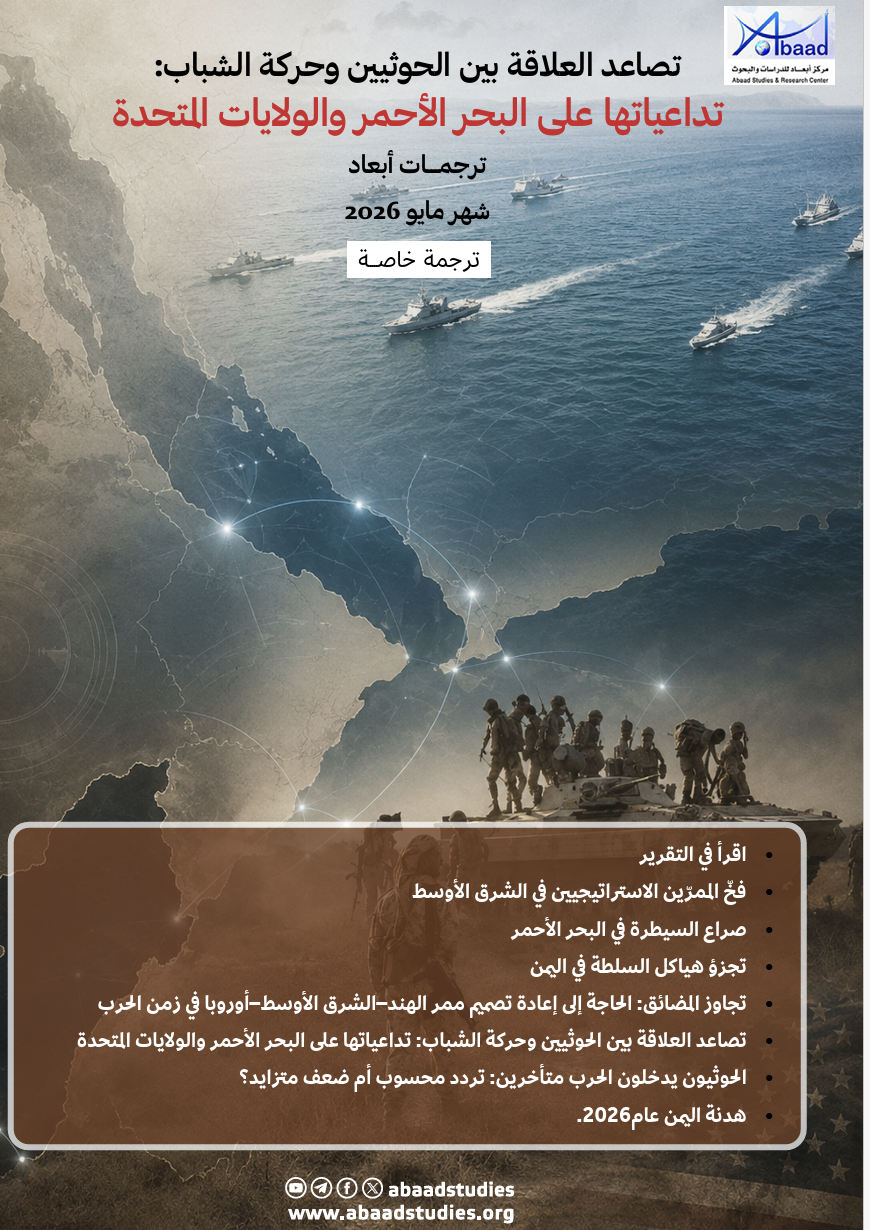
For the fifth consecutive year, Abaad Studies and Research Center continues to publish special translations of international reports and research papers addressing developments in Yemen as part of the Abaad Observatory program.
In its May 2026 issue, Abaad Translations focused on geopolitical and security transformations in Yemen, the Red Sea, and the broader Middle East, amid intensifying international competition, the growing strategic importance of maritime corridors, and the overlapping crises involving Yemen, Iran, the Houthis, Al-Shabaab, and the global economy.
The issue brought together a set of reports and analyses examining the growing relationship between the Houthis and Al-Shabaab, the risks of closing the Strait of Hormuz and Bab al-Mandab, the struggle for control in the Red Sea, the fragmentation of power structures in Yemen, the need to redesign the India–Middle East–Europe Corridor, and a reading of Yemen’s 2026 truce.
The issue suggests that the Red Sea is no longer merely a maritime route for trade and energy. It has become a central arena for reshaping regional and international influence, where the interests of the United States, China, the European Union, Türkiye, Iran, and Gulf states intersect with the roles of non-state actors, foremost among them the Houthis and Al-Shabaab.
The Relationship Between the Houthis and Al-Shabaab
The first report in the issue examined the growing relationship between the Houthis in Yemen and Al-Shabaab, the Al-Qaeda-linked movement in Somalia. It noted that this cooperation has included arms exchanges, training, and the transfer of military technologies of Iranian origin.
According to the report, this relationship is based on an indirect exchange: the Houthis gain access to smuggling routes, illicit networks, and piracy activities in the Gulf of Aden, while Al-Shabaab receives more advanced weapons and military expertise.
The report warns that this relationship is not merely a local threat, but carries wider international implications. It strengthens the capabilities of both actors, expands the spread of Iran-linked military technology, and increases the fragility of security in the Red Sea and Bab al-Mandab, particularly amid continued tensions between the United States, Iran, and Israel.
The report concludes that dealing with the Houthis and Al-Shabaab separately is no longer sufficient. Curbing this relationship requires more comprehensive policies, as well as broader maritime and intelligence coordination.
The Trap of the Two Strategic Chokepoints in the Middle East
Another report discussed the risks posed by simultaneous threats to the Strait of Hormuz and Bab al-Mandab. It argued that the closure of either chokepoint would have serious consequences for the global economy, while the closure of both could trigger a major shock to energy markets and international trade.
The report notes that the Strait of Hormuz remains a key passage for oil and gas trade, while Bab al-Mandab represents a vital gateway linking the Gulf of Aden, the Red Sea, and the Suez Canal.
It emphasizes that Bab al-Mandab receives less attention in public debate than Hormuz, despite its critical importance. If the Houthis decide to close this route, global shipping would be forced to reroute around the Cape of Good Hope, increasing transit times and raising costs.
The report also argues that although the Houthis are linked to Iran’s axis, they have demonstrated an ability to make independent decisions in using Bab al-Mandab as a pressure card. This makes any approach that treats them merely as an Iranian proxy analytically incomplete.
The Struggle for Control in the Red Sea
The report titled “The Struggle for Control in the Red Sea” focuses on the transformation of ports, maritime corridors, military bases, undersea cables, and energy routes into tools of competition among global and regional powers.
The report argues that the Red Sea has become a focal point of geostrategic rivalry, and that continued instability could disrupt global trade and energy flows.
It maps the region’s spheres of influence, where the U.S. military base in Djibouti stands close to China’s first overseas military base, while Beijing expands its presence through infrastructure investments and the Maritime Silk Road Initiative.
The report also examines the presence of the UAE, Saudi Arabia, Israel, Iran, and Türkiye in the Red Sea and the Horn of Africa, noting that the region is no longer dominated by a single power, but is instead shaped by complex competition among states, global powers, and armed non-state actors.
Fragmentation of Power Structures in Yemen
On Yemen’s domestic front, one report addressed the fragmentation of power structures in the country. It explained that the war has produced a fragmented governance system in which institutional and territorial authority is distributed among multiple non-state actors.
The report does not view this as a complete collapse of the state, but rather as a shift toward an adaptive model of governance imposed by necessity and structural transformation.
It notes that the internationally recognized government continues to suffer from limited administrative and political presence, while local actors and de facto authorities exercise varying degrees of influence across different areas.
The report concludes that the absence of a unified national center of authority deepens state fragility. At the same time, it reveals alternative patterns of local governance that maintain a minimum level of services and administration in an extremely fragile economic and humanitarian environment.
Beyond the Chokepoints: Redesigning the India–Middle East–Europe Corridor
Another report examined the need to redesign the India–Middle East–Europe Corridor in light of the Iran-linked conflict and the transformation of trade routes into direct strategic targets.
The report argues that the corridor was originally designed for a time of peace, while current crises reveal the need to rethink it within a regional environment that has become far more volatile.
It stresses that no economic corridor can succeed without political support from regional partners, or without alternative and flexible routes capable of redirecting trade during crises.
From this perspective, the report calls for building greater resilience through route diversification and linking infrastructure projects to diplomacy and crisis-management mechanisms, rather than treating them as economic projects isolated from the security context.
The Houthis and Regional Escalation: Delayed Entry or Tactical Calculations?
The issue also included a report examining the timing of the Houthis’ involvement in regional escalation, and whether their delayed entry reflects tactical calculations or growing limitations in capability.
The report links the resumption of Houthi attacks toward Israel in March 2026 to a political discourse that frames these operations within alignment with Iran in the broader regional conflict.
It notes that Houthi movements cannot be read solely as a direct extension of Iranian decision-making. They should also be seen as part of an attempt by the Houthis to reassert their regional position and to use the Red Sea and Bab al-Mandab as tools of political and security pressure.
Yemen’s 2026 Truce
The report on Yemen’s 2026 truce presents the truce as a complex political phenomenon that combines limited stability with the continued dynamics of conflict and the risk of fragmentation.
It argues that Yemen is no longer a traditional battlefield, but it has not entered a stable peace either. Instead, the country is living through a state of low-intensity, suspended violence that is constantly being reshaped by regional and international power balances.
The report notes that the official UN-sponsored truce of 2022 ended after a short period, yet its effects continued through an informal balance that produced partial de-escalation: neither full-scale war nor comprehensive peace.
This situation reveals the difficulty of moving toward a genuine political settlement amid continued military and institutional division, and the overlap of local calculations with regional and international influences.
Conclusion
Abaad Translations – May 2026 concludes that Yemen, the Red Sea, and Bab al-Mandab have become central to a broader strategic equation in which war and peace, economy and security, maritime corridors, and international competition increasingly intersect.
The threat is no longer confined to Yemen’s internal front. It now extends to maritime security, energy flows, and global supply chains.
This package of translations underscores that treating Yemen merely as a local crisis is no longer sufficient. Due to its geography, the multiplicity of armed actors, and the overlap of Iranian and international influence, Yemen has become part of a wider struggle over the Red Sea and the regional order.
Accordingly, any future approach to the Yemeni crisis must link the internal peace process with maritime security, state reconstruction, the disruption of smuggling networks, and the development of more effective regional and international mechanisms for crisis management.