





Abaad’s Research Activities in June: A Study on US-Iran Negotiations and Their Implications for Yemen, the Early Warning Report, and Multiple Translations
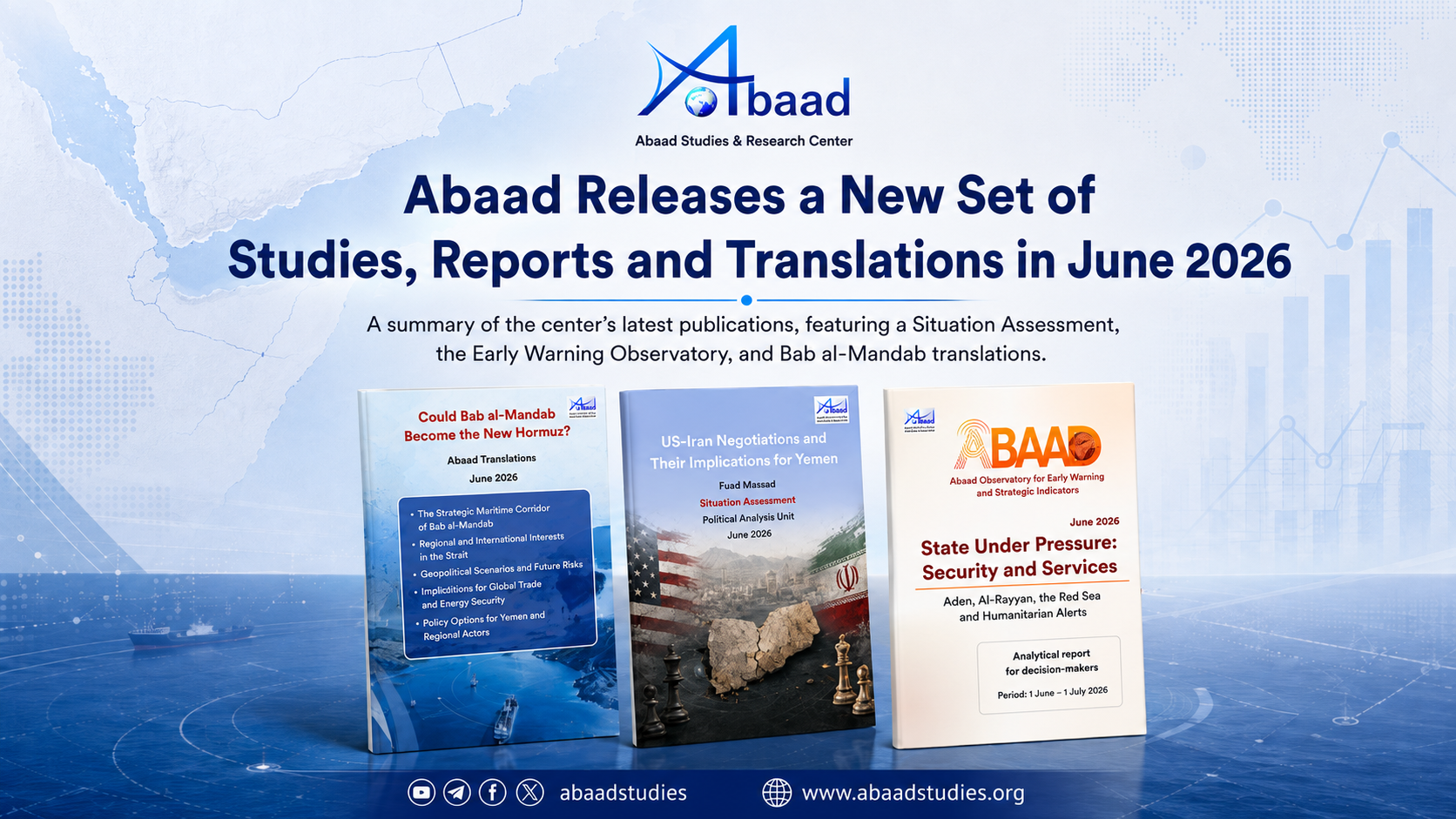
Abaad Studies & Research Center released during June 2026 a package of research, analytical, and translated publications focusing on Yemen’s position within regional and international transformations, internal risk indicators linked to security, services, and the Red Sea, as well as translated international debates on the future of Bab al-Mandab and the Strait of Hormuz.
The publications included a Situation Assessment titled “US-Iran Negotiations and Their Implications for Yemen,” a monthly report issued by the Abaad Observatory for Early
Warning and Strategic Indicators titled “State Under Pressure: Security and Services,” and a translations file titled “Could Bab al-Mandab Become the New Hormuz?”
US-Iran Negotiations and Their Implications for Yemen
In its Situation Assessment, Abaad Studies & Research Center examined the ongoing negotiations between the United States and Iran as a regional milestone where several files intersect, including Iran’s nuclear program, regional security, and the protection of global shipping routes, particularly the Strait of Hormuz and the Red Sea. The study raised a central question about the extent to which these negotiations could affect the war in Yemen, and whether they could advance the path toward a settlement or merely manage the conflict and reduce its cost.
The study argues that Yemen does not appear to be explicitly present in the negotiations between Washington and Tehran, but it remains part of the indirect calculations, especially through the Red Sea and Bab al-Mandab. It identified three possible patterns for Yemen’s presence in the negotiation track: indirect presence through Iran’s use of Houthi escalation in the Red Sea as a bargaining card; inclusion of the Yemeni file within a broader regional de-escalation framework linked to maritime security; or deliberate exclusion, leaving the Yemeni file to regional understandings led by Saudi Arabia and Oman.
The study concludes that any US-Iran understanding may reduce the intensity of some conflicts in the region, including Yemen, but it would not be sufficient to end the Yemeni war entirely. This is because the conflict in Yemen is no longer merely a regional bargaining card, but has become a multi-layered conflict in which local and regional dimensions overlap. If the negotiations succeed, the study suggests this could be reflected in a reduction of Iranian support to the Houthis, fewer cross-border attacks, and a more favorable political environment for local and regional negotiations.
The study outlines several scenarios for the future of the Yemeni war. The first is de-escalation and reduced tensionsunder a partial agreement between Washington and Tehran, which could open a window for progress in Yemeni negotiations under regional sponsorship and international support. The second is conflict freeze, in which the truce continues and the parties avoid escalation, but without real peace or a full-scale war. The third, which can be inferred from the logic of the study, is renewed escalation if understandings fail or if regional leverage cards, including the Houthis and the Red Sea, are turned into tools of mutual pressure between Washington and Tehran.
Early Warning Report: State Under Pressure
In the second publication, the Abaad Observatory for Early Warning and Strategic Indicators presented its June 2026 report titled “State Under Pressure: Security and Services — Aden, Al-Rayyan, the Red Sea, and Humanitarian Alerts.” The report defines the observatory as an analytical tool designed to transform daily monitoring of events, data, and reports into readable and assessable indicators, relying on human analysis and AI-assisted tools to sort material, detect patterns, and classify indicators.
The report found that June was an intense month in terms of political, security, economic, humanitarian, and social indicators. The Yemeni scene moved along five overlapping tracks: a political track seeking to reassert the authority of the state; a security track marked by rising assassinations, cells, and maritime threats; an economic and services track pressuring the government through electricity, salaries, and fuel; a humanitarian track in which indicators of displacement, hunger, mines, and violations accumulated; and a social and tribal track that emerged in Al-Jawf through the Al-Rayyan gatherings.
The report considers that the Yemeni state is facing a dual test: restoring the authority of institutions from within, and preventing Yemen from being turned into a platform for threats in the Red Sea and the wider region. It notes that the security file is no longer confined to frontlines, but has moved into the heart of cities and government-held areas through assassinations, cells, tensions within security facilities, and the multiplicity of security bodies. Meanwhile, the Red Sea and Bab al-Mandab have returned as a strategic warning file linked to the seizure of drone-manufacturing equipment, maritime attacks, and threats to navigation.
On the social and tribal level, the report highlights the case of Sheikh Hamad bin Rashid bin Fadgham Al-Hazmi and the Al-Rayyan encampments in Al-Jawf, considering it an early indicator of tribal discontent that could develop into broader social or political pressure against the Houthis if the issue expands or is mishandled. It also points out that issues linked to tribal concepts such as protection, restoration of honor, and tribal dignity may be more capable of mobilizing tribes than traditional political rhetoric.
On the humanitarian side, the report recorded more than 3.1 million displaced people in government-held areas, around 60 percent of whom are in Marib. It also noted warnings over funding shortages, worsening food insecurity, rising indicators of disease, mines, and war remnants, making the humanitarian crisis part of the political and security risk rather than a separate file.
Translations: Bab al-Mandab at the Center of International Debate
The translations file, titled “Could Bab al-Mandab Become the New Hormuz?”, included a set of translated materials focusing on the Strait of Hormuz crisis, Yemen’s importance in the new Gulf economic map, Houthi threats to navigation, the impact of disruption in Bab al-Mandab on the global economy and oil markets, as well as an investigation into Yemen’s gold route toward Dubai.
The importance of this file lies in bringing to the Arab reader part of the international debate on Yemen and maritime chokepoints. One of the translated materials notes that the Houthis have retained a significant leverage card: the ability to disrupt commercial shipping through Bab al-Mandab, a passage linking the Red Sea with the Gulf of Aden and carrying more than 10 percent of global seaborne trade.
The file also notes that Bab al-Mandab, which connects the southern Red Sea to the Gulf of Aden, carried around 10 percent of global seaborne trade before Houthi attacks, but that share declined to nearly 3 percent in 2025, according to the file’s citation of international data.
The translations align with the conclusions of the center’s two studies in emphasizing that Yemen is no longer merely a local conflict zone, but has become part of the broader equation of energy security, trade, and supply chains. Tensions in Bab al-Mandab do not threaten Yemen alone; they also affect the Suez Canal, the Horn of Africa, oil markets, and shipping routes between Asia and Europe.