





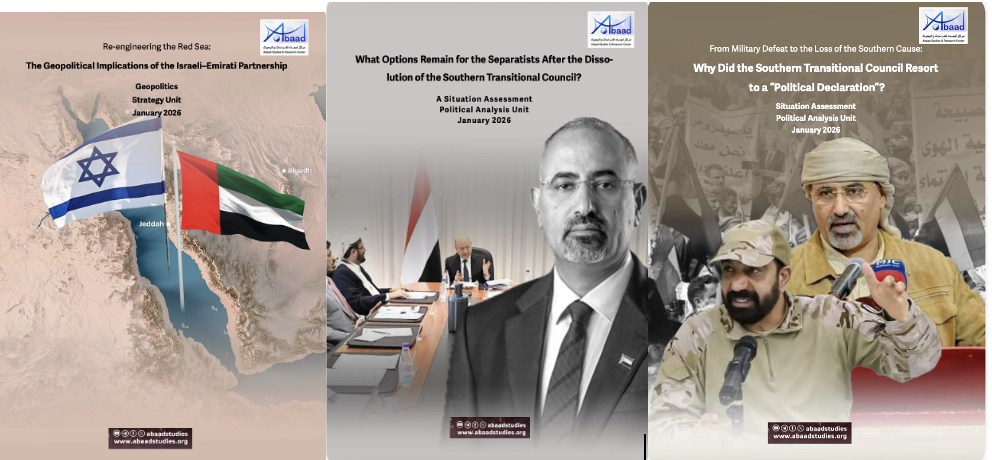
The Aba'ad Center for Studies and Research has issued a new strategic assessment examining post–Southern Transitional Council (STC) scenarios, alongside the implications of Israeli and Emirati military and diplomatic activities for Saudi national security and the broader Arab security system.
Released in January, the assessment forms part of the Center’s ongoing political study tracking developments in Yemen and the wider region. It comprises three in-depth analytical studies, each addressing a key dimension of the evolving regional landscape.
The first study, a situational assessment titled “From Military Defeat to the Loss of the Southern Cause: Why Did the Southern Transitional Council Resort to a Political Declaration?”, analyzes the temporal and contextual factors behind the collapse of the STC and its military formations. It assesses the potential implications of recent developments, including the restoration of government control over southern and eastern governorates and the political preparations for an inclusive southern conference under Saudi auspices. The study also outlines the most likely short-term scenarios emerging from these shifts.
The second study, a situation assessment entitled “What Options Do Secessionists Have After the Dissolution of Their Entity (the Southern Transitional Council)?”, examines the orientations of emerging leaderships in southern and eastern Yemen following a series of decisive developments. These include the expulsion of the United Arab Emirates from Yemen and the Arab Coalition, the dissolution of the STC after its military and political defeat, the flight of its chairman Aidarous al-Zubaidi, and the revocation of his membership in the Presidential Leadership Council on charges of high treason.
This study raises fundamental questions about the future of secessionist forces after the decision to dissolve the STC. It argues that the transition from a political–military entity to a phase focused on reshaping influence within the state represents a critical turning point. Such a transition, the study notes, requires an analytical framework that links the dismantling of armed movements with the reconstruction of local governance and State institutions, while recognizing that the influence of such entities is determined not only by formal structures but also by the depth and resilience of their supporting networks.
The study further explores the future of southern and eastern governorates following the STC’s dissolution and the departure of its leader from the political scene. It assesses the options available to new leaderships in managing local authorities and State institutions amid rapid political changes and mounting challenges, and presents the most likely scenarios based on current indicators and rapid developments.
The third study, a geopolitics paper titled “Re-Engineering the Red Sea: The Geopolitical Implications of the Israeli–Emirati Partnership,” focuses on the impact of this partnership on Saudi national security and the Arab security architecture as a whole, particularly following Israel’s recognition of ‘Somaliland.’
According to the study, the Red Sea and the Horn of Africa are undergoing a profound transformation marked by the structural erosion of security arrangements that prevailed in the post–Cold War period. The fragile balance that once governed the region has collapsed, giving way to a new, more volatile and competitive security order driven by the convergence of strategic interests within what the study describes as a perilous Israeli–Emirati axis. This alliance has moved beyond diplomatic normalization toward a deep security partnership, triggering a series of rapid actions that are redefining power balances and control over critical maritime routes.
The study also notes that developments over the past two years (2024–2025) have effectively merged the security systems of the Middle East and the Horn of Africa into a single, highly interconnected framework referred to as the “Red Sea Security Complex.” This growing interdependence, it argues, now dominates the regional landscape, where a diplomatic decision in Hargeisa can trigger a political crisis in Aden across the same body of water, while simultaneously causing security destabilization in Gulf markets—developments that have necessitated Pakistani military deployments.