





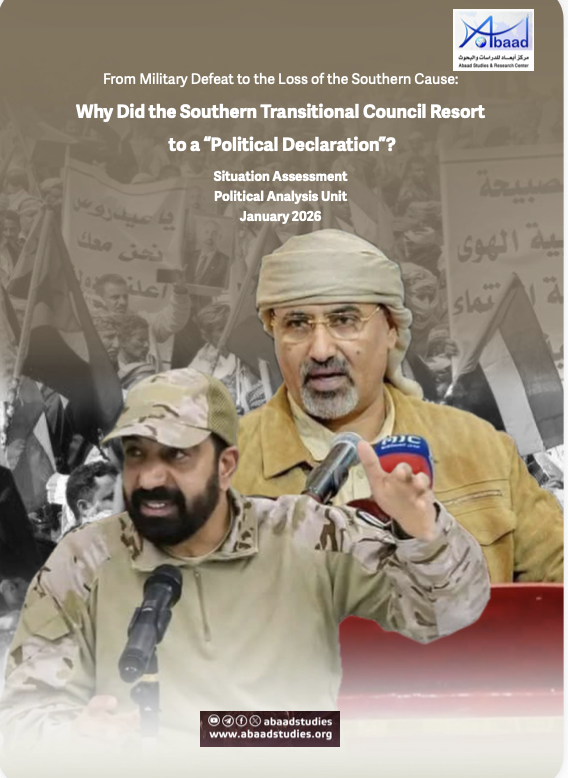
From Military Defeat to the Loss of the Southern Cause:Why Did the Southern Transitional Council Resort to a “Political Declaration”?
Executive Summary
Recent developments in eastern Yemen have created a new political and security landscape—one that extends beyond what the Southern Transitional Council (STC) had sought to preserve and leverage as a pathway toward declaring southern secession.
The dynamics generated by the “handover of military camps” operation and the rapid reassertion of state control in the east in recent days—including the forced removal of STC‑affiliated units, supported by Arab Coalition air support backing the internationally recognized government—have pushed the STC away from the existing partnership framework. In response, on 2 January the STC issued a political declaration announcing a two‑year transitional phase, to be followed by a referendum on the secession of South Yemen. The declaration called on Yemeni parties to enter dialogue to regulate the transitional period and pave the way for the referendum; failing that, the STC threatened it would declare secession without waiting for the two years to elapse.
In parallel, Riyadh welcomed preparations for an inclusive conference bringing together southern factions to explore a fair solution to the Southern Issue—one that rejects exclusion, marginalization, or the monopolization of representation by a single actor claiming exclusive legitimacy. This approach directly challenges the monopoly the STC has sought to entrench since its establishment, indicating that escalation is likely to feature prominently in the period ahead.
This assessment reviews the timing and substantive drivers of the STC’s declaration and considers its implications in light of emerging facts on the ground: militarily, through the state’s renewed control in Hadramout; and politically, through Saudi‑sponsored preparations for a broader southern consultative track. It concludes by outlining the most likely near‑term scenarios.
Timing and Context (Chronological and Substantive)
Just hours after government forces took control of most areas of Hadramout—and after STC fighters withdrew from camps they had previously controlled—the STC chairman issued a political declaration announcing the “start of a transitional phase lasting two years, followed by a referendum on southern secession.”
The timing is telling. The STC appears to have chosen a strategy of political flight forward, elevating the secession agenda to offset a sweeping setback in Hadramout and Al‑Mahrah. STC positions collapsed quickly under Saudi‑led Coalition airstrikes and amid sustained advances by the Nation’s Shield forces (Dara’ Al‑Watan) and the Hadramout Protection Forces, affiliated with the Hadramout Tribes Alliance led by Sheikh Amr bin Habrish.
After the STC’s Expulsion from Hadramout and Al-Mahrah
The STC’s declaration also appears intended to blur—or reframe—the new realities taking shape in eastern Yemen after its political and military defeat. This is particularly notable given that STC‑aligned units had, as recently as last month, rejected any discussion of withdrawing from Hadramout and Al‑Mahrah.
After taking control of these areas in early December, the STC moved quickly to mobilize supporters around sit‑ins calling for a declaration of southern secession. The objective was to generate political cover that would (1) avoid serious engagement with other Yemeni parties and Saudi Arabia on the need to withdraw from Hadramout and Al‑Mahrah, and (2) present the incursion as part of a broader plan to prepare the ground for proclaiming a southern state.
The STC went further by pressuring its members within the government and ministries to issue statements endorsing the leadership’s move to seize Hadramout and to “operationalize” secession. These steps triggered resentment among its partners within the internationally recognized government and within the Arab Coalition’s leadership. Saudi Arabia—seeking to reduce escalation, contain tensions in the east, and preserve a workable level of partnership among Yemeni parties within the recognized government—viewed the STC’s actions as a direct escalation.
At this stage—amid STC escalation reportedly supported by Abu Dhabi—a Yemeni sovereign decision, backed by Saudi Arabia, was taken to remove the United Arab Emirates from Yemen. Riyadh swiftly endorsed the move. At dawn on Tuesday, 30 December, Coalition aircraft carried out strikes on weapons reportedly unloaded from two ships that had arrived from the Emirati port of Fujairah in December 2025.
Against this backdrop—the UAE’s exit, the strikes on Emirati weapons, and the success of the “handover of camps” operation led by the internationally recognized government and the Nation’s Shield forces under Hadramout Governor Salem Al‑Khanbashi (appointed commander only hours before the operation began)—the government rapidly reasserted control across Hadramout and expelled STC forces from all areas they had held. The STC was left facing a reversal it did not anticipate. It responded with a political pivot: an attempt to blunt a major defeat by returning to its preferred instrument—renewed recourse to a secession announcement.
The STC appears to calculate that being forced out of Hadramout and Al‑Mahrah—and restoring conditions to the pre‑takeover status quo—would constitute a painful military and political loss, with consequences extending beyond the two governorates to the broader southern arena. In the weeks leading up to the reversal, the STC projected firmness in the face of Saudi‑led de‑escalation efforts and sustained demands from state leadership, the government, local authorities, and political and social actors. That posture, however, quickly eroded under pressure, exposing practical limitations in its ability to hold ground.
The STC also seems to have assumed it could compel Yemeni parties to accept its control over Hadramout in exchange for tempering escalation toward a formal secession declaration—drawing on a pattern of pressure tactics and political brinkmanship. What it misjudged was Saudi Arabia’s threshold for moves perceived to affect its national security and regional posture. The Saudi response—unexpectedly forceful—was enough to unsettle the STC, particularly as it extended beyond the STC itself to its backers in Abu Dhabi.
Escaping Defeat—and the Consequences
The STC’s declaration calls on Yemeni actors to enter what is, in effect, a conditional and pre‑scripted dialogue: a process led by the STC, with the agenda and subject already set. The stated purpose is to prepare for a referendum, while treating its outcome as effectively settled—implicitly conditioned on a vote for southern secession. Should Yemeni parties reject this invitation—as the STC appears to anticipate—the declaration asserts that the STC would then have the right to announce unilateral secession and establish a “State of the South.”
The STC thus frames responses to its initiative as a binary choice, allowing no middle ground: either participate in an STC‑led process whose engineered endpoint is a referendum designed to deliver secession, or refuse to join what would amount to a one‑sided exercise in which meaningful negotiation is absent and the STC remains the only real decision‑maker. In the second case, the declaration positions secession as ready to be announced, alongside a prepared justification: we offered dialogue, you refused, and we cannot wait.
More significantly, the statement signals a political break with the existing partnership framework—with the internationally recognized government and the Saudi‑led Arab Coalition. In other words, the STC no longer presents itself as a partner within a consensus‑based authority arrangement, but as a stand‑alone de facto authority in the areas it controls—a shift that is likely to be recognized by both allies and adversaries.
Although the declaration attempts to address the international community, its primary audience appears to be domestic. Even so, the messaging is marked by internal tension: it calls for dialogue while simultaneously prescribing its content, conditions, and outcome. It also advances a referendum framed as having a predetermined result, reducing the proposed dialogue to a procedural step toward a foregone conclusion.
A Saudi-Sponsored Inclusive Conference on the Southern Issue
Following the issuance of the STC statement, a broad Southern coalition emerged with the aim of breaking the monopoly on the Southern Cause, rejecting the notion that it is an exclusive entitlement belonging to the STC alone. This coalition expressed its rejection of what it termed the "unilateral measures" taken by Aidarus Al-Zubaidi.
This alignment—fronted by Dr. Abdullah al-Alimi, a member of the Presidential Leadership Council, alongside the Prime Minister and the Speaker of the Shura Council—took shape in a statement signed by more than ten southern groupings, as well as dozens of political figures, ministers, and senior state officials from the southern and eastern governorates. Signatories reportedly included former prime ministers, ministers, ambassadors, and members of parliament, in addition to five advisors to the President.
In their statement, they called upon the President of the PLC to convene an inclusive conference sponsored by Riyadh. The objective is to develop a holistic vision for resolving the Southern Cause, taking into account its historical, political, and social dimensions, without excluding or marginalizing any Southern component.
Accordingly, PLC President Rashad al-Alimi formally requested Saudi leadership to host and sponsor the conference in Riyadh. Saudi Arabia’s Ministry of Foreign Affairs welcomed the Yemeni request and expressed readiness to host an “inclusive conference bringing together all southern components to discuss fair solutions to the issue of South Yemen.”
Implications and Scenarios
At the moment the STC assumed it had shifted the burden onto its opponents, it was confronted with an alternative “dialogue” card: an official invitation for southern actors to discuss fair solutions to the Southern Issue under Saudi sponsorship. This deprives the STC of its principal advantage—its long-standing effort to monopolize representation of the Southern Issue and deploy it against rivals, using the threat of secession whenever it finds itself cornered.
The landscape now points to several possible scenarios, depending on responses to the STC’s declaration and to the Presidency’s—alongside Saudi Arabia’s—call for an upcoming southern dialogue, especially given developments in the east where the prevailing momentum is moving against the STC’s preferences.
Scenario 1: Further STC escalation through New Declarations and decisions (most likely)
Given that the STC conditioned the two-year delay of the referendum on the condition of being included in a dialogue and the cessation of operations against its forces—neither of which has occurred—it is expected that the STC will continue to escalate toward secession. This is reinforced by the lack of engagement from Yemeni parties (North and South) with its call for dialogue, and the fact that the campaign to restore state influence in Hadramout and Al-Mahrah is proceeding at a high tempo.
As for the Saudi-sponsored southern dialogue conference, the STC may avoid it because it would not be the sole protagonist. Its seat at the table would be that of one component among several southern actors—an arrangement it is neither accustomed to nor likely to accept.
Conversely, preparations for the Riyadh conference will proceed with the participation of numerous Southern factions and figures. The STC will view this as a disregard for its own invitation, providing—from its perspective—justification to leap further into the unknown. Escalation will be seen as the only exit from the repercussions of its broken power in the Eastern governorates—a fracture that will not stop at the borders of Shabwah or the Al-Abr desert, but will likely extend deep into its main strongholds, including Aden and neighboring governorates.
This scenario is further reinforced by the fact that relations between the STC and the government have reached a dangerous inflection point, as have STC–Saudi relations. In STC statements and rhetoric, Saudi Arabia has increasingly been described as an “enemy,” and the STC has accused it of “supporting terrorism and terrorist organizations” because of its backing for the internationally recognized government and local authorities in Hadramout and Al-Mahrah.
If escalation continues and efforts to reassert state authority persist, the STC could lose significant elements of the influence and coercive power it has built—reportedly with Emirati support—over recent years. Should successive blows accumulate, the dismantling of the STC could become a plausible outcome.
Scenario 2: Saudi containment that returns the STC to partnership and freezes its declaration
Although relations between Saudi Arabia and the STC have reached a deadlock due to the latter’s intransigence and refusal to voluntarily withdraw from Wadi Hadhramaut, the possibility of Saudi containment remains. This is particularly viable if Riyadh succeeds in co-opting certain STC leaders who feel that Al-Zubaidi’s recent decisions have squandered the gains of previous years. This might involve ousting Al-Zubaidi and holding him responsible for the rigid stance taken from the invasion of Hadramout and Al-Mahrah up to the recent political statement. Notably, Saudi media has recently focused on al-Zubaidi personally—especially questions surrounding his alignment with the UAE and whether he is driving his followers toward an uncertain trajectory.
This scenario entails the STC’s participation in the upcoming dialogue on the Southern Cause, implying a return to partnership with the legitimate government and a freezing of its political statement regarding secession. This would leave the STC in an ambiguous and unconvincing position, particularly in the eyes of its supporters who mobilized for over a month awaiting "Declaration No. 1"—i.e., a formal declaration of secession and the establishment of a new state.
Scenario 3: Schism within the STC Ranks
This scenario depends on the ability of the internationally recognized government and the Coalition to achieve a breakthrough within the STC—particularly among influential, operational leaders—by pulling them away from al-Zubaidi’s inner circle. In the latest events, al-Zubaidi has been depicted as acting like a Yemeni analogue of Sudan’s Hemedti: executing Emirati directives without due consideration of consequences and fallout. This view has been reinforced by Saudi leadership and press narratives; the statement by the Saudi Ambassador to Yemen served as a prime example, distinguishing between the STC as an entity and al-Zubaidi’s actions, which were described as having inflamed the environment and pushed developments toward confrontation.