





Abaad Expands Research Output in July with Focus on Sovereignty, Tribal Dynamics and Regional Escalation
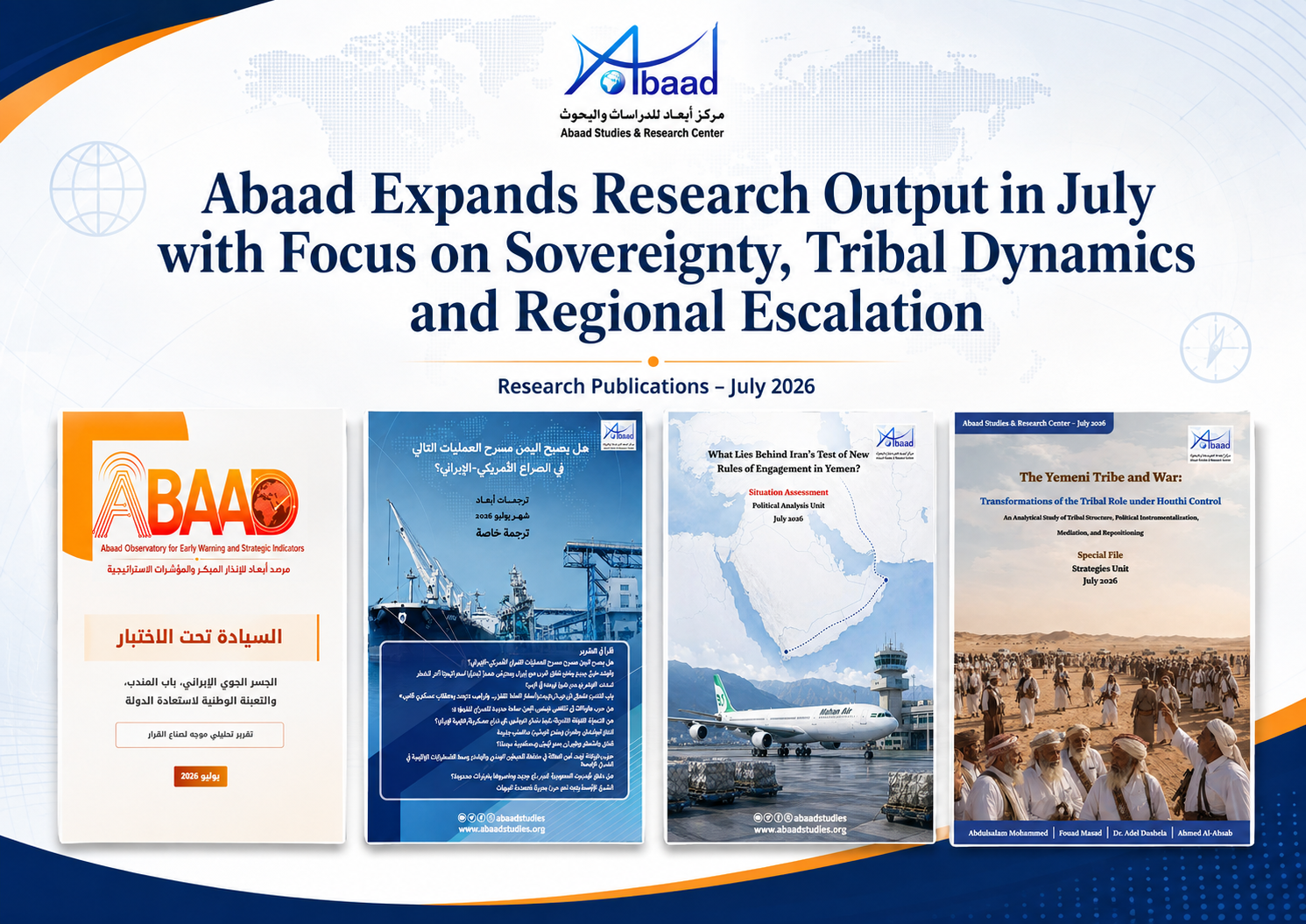
Abaad Studies and Research Center intensified its research and analytical activities during July 2026, releasing a series of publications addressing Yemen’s sovereignty, Iranian involvement, tribal transformations, maritime security and the growing risk of the country becoming part of a wider regional confrontation.
The July output included an early-warning report, a special analytical study, a political assessment and a collection of translated international analyses. Together, the publications sought to provide policymakers, researchers and other stakeholders with focused assessments of the rapidly changing political, military and social environment in Yemen.
Early-Warning Observatory: Yemen’s Sovereignty Under Pressure
Abaad’s Observatory for Early Warning and Strategic Indicators released its July report under the title “Sovereignty Under Test: The Iranian Air Bridge, Bab al-Mandab and National Mobilisation to Restore the State.”
The report assessed Yemen’s overall risk level as red and extremely high, arguing that the country’s crisis had moved beyond domestic military confrontation into a broader struggle over national sovereignty and regional security.
It highlighted reported Iranian flights to Sana’a, attempts to establish an air-supply route to the Houthis, escalating threats to shipping in the Red Sea and Bab al-Mandab, and heightened military preparedness across government-held areas. The report also examined developments in the political, economic, humanitarian and tribal arenas, including the growing tribal mobilisation in Al-Rayyan, Al-Jawf.
The observatory said its monthly methodology combines daily monitoring with the classification and analysis of political, military, economic, humanitarian and tribal indicators. It also uses artificial-intelligence tools to assist with sorting information and detecting patterns, while retaining human editorial and strategic assessment as the basis of the final report.
Special Study Examines the Changing Role of Yemen’s Tribes
Abaad also published the first part of its 2026 book project, titled “The Yemeni Tribe and War: Transformations of the Tribal Role under Houthi Control.”
Prepared by Abdul Salam Mohammed, Fouad Musaad, Dr Adel Dashela and Ahmed Al-Ahsab, the study examines the structure of Yemen’s tribes, their relationship with the state, their role in conflict management and mediation, and their changing position since the Houthis took control of Sana’a and large areas of northern and western Yemen.
The publication argues that the tribe has not disappeared as a social and political actor but has been subjected to a process of coercive restructuring. In some areas, tribal communities have become parties to the conflict, while in others they continue to function as local mediators capable of reducing violence and resolving disputes.
The study further examines the Houthis’ transition from alliance-building and tribal co-option to direct control through the supervisory system, military recruitment, financial levies, the marginalisation of traditional sheikhs and the use of religious and ideological mobilisation.
It concludes that the Houthis have achieved a degree of tactical success in mobilising tribes and containing opposition, but that this control remains vulnerable because of human losses, economic pressures, social fragmentation and declining confidence in tribal leaders associated with the group.
Political Assessment: Iran Tests New Rules of Engagement in Yemen
In a separate political assessment, Abaad examined the implications of the reported arrival of an Iranian aircraft at Sana’a International Airport on 3 July 2026.
Published under the title “What Lies Behind Iran’s Testing of New Rules of Engagement in Yemen?”, the assessment argued that the flight represented more than a civilian aviation movement. It described it as a multidimensional political, security and sovereignty test intended to establish a new precedent for direct air links between Sana’a and Tehran.
The paper linked the flight to wider Iranian efforts to strengthen the Houthis’ regional role, test the reactions of the internationally recognised Yemeni government and Saudi Arabia, and potentially transport personnel or equipment with military applications.
It also noted that the use of a wide-body Mahan Air Airbus A340, together with its indirect route near Omani airspace and across the Arabian Sea, indicated an unusual logistical operation that differed from the limited humanitarian flights previously associated with Sana’a Airport.
The assessment warned that consolidating a regular air corridor between Tehran and Sana’a could alter the rules that have governed the Yemeni conflict since 2015 and further internationalise a crisis already connected to Red Sea security, global trade and energy routes.
July Translation File Tracks the Risk of a Wider Regional War
Abaad’s translation programme issued a special July collection titled “Will Yemen Become the Next Theatre of Operations in the US-Iranian Conflict?”
The file brought together translated international articles and analyses examining the Houthis’ maritime threats, the possibility of direct US military action, the implications of simultaneous disruption in the Strait of Hormuz and Bab al-Mandab, and Yemen’s growing role in Iran’s regional deterrence strategy.
The collection also covered the risks of renewed Houthi-Saudi tensions, the impact of proxy warfare on global energy security and the possibility that the Red Sea could become part of a multi-front maritime confrontation.
One of the translated analyses argued that any direct US military action against Houthi targets would challenge Iran’s strategy of empowering non-state partners to impose costs on its adversaries while avoiding direct interstate confrontation. It also highlighted the importance of Bab al-Mandab as a major international trade route and the potential global consequences of simultaneously disrupting it and the Strait of Hormuz.
Research Agenda Centred on Yemen’s Regional and Internal Transformations
Abaad’s July publications reflected a research agenda centred on the interaction between Yemen’s internal conflict and wider regional developments.
Across the four releases, the center focused on three main trends: the growing challenge to Yemen’s sovereignty, the transformation of the Houthis into a regional military actor linked to Iran, and the continuing importance of tribal structures in conflict, resistance, mediation and future state-building.
The July output also demonstrated the center’s effort to combine early-warning monitoring, political assessment, long-form research and translated international perspectives in order to provide decision-makers with a broader understanding of Yemen’s evolving risks and possible future scenarios.