





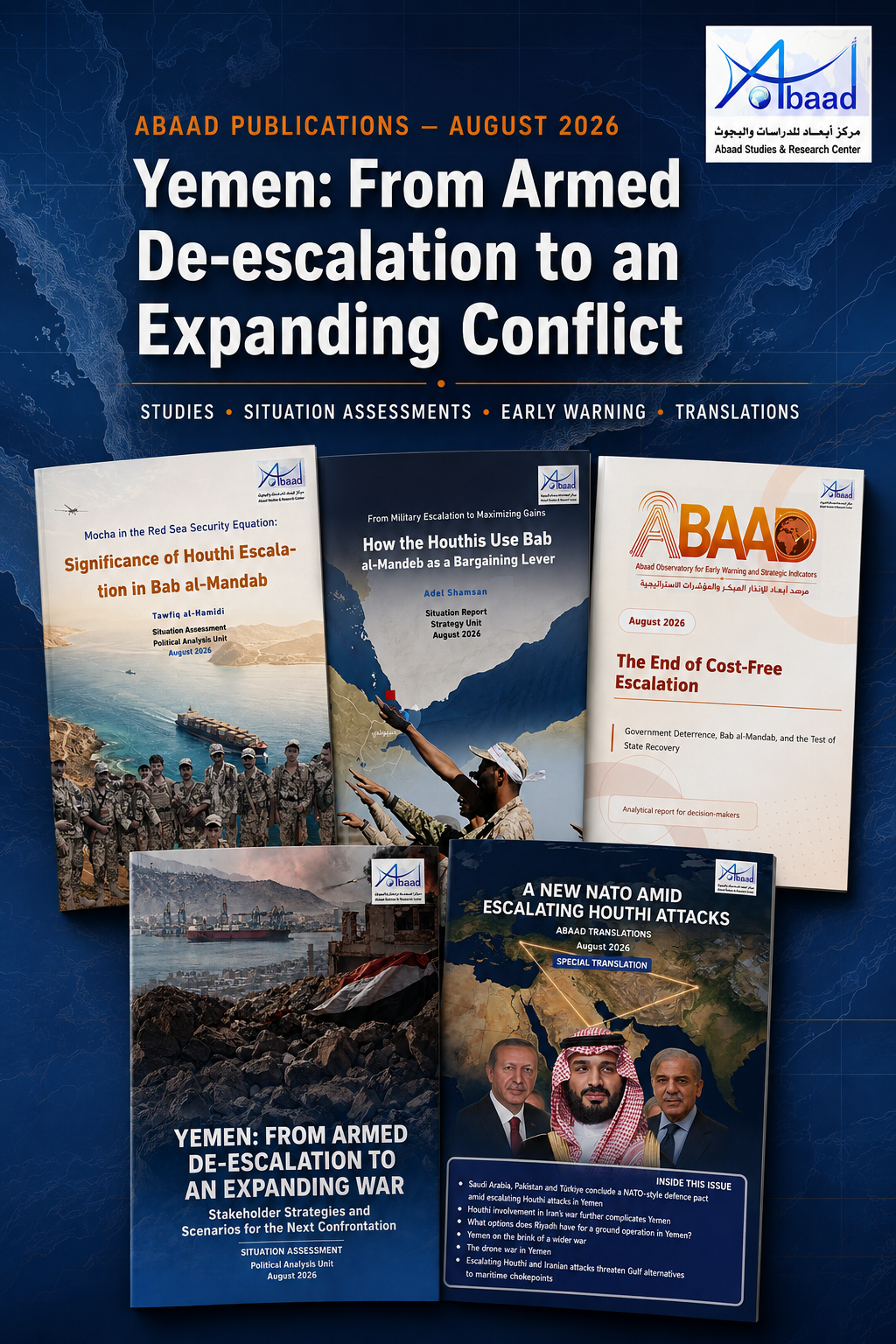
Abaad Studies and Research Center issued five publications in August 2026 examining Yemen’s expanding military confrontation, the Houthis’ use of Bab al-Mandab as an instrument of pressure, Mokha’s growing strategic importance, early-warning indicators, and international assessments of Yemen’s changing regional environment.
Together, the publications indicate that Yemen is moving from a period of armed de-escalation into a new phase of escalation and mutual deterrence. Ground fighting is increasingly intertwined with missiles, drones, maritime operations and economic pressure, while control of airspace, ports and sea lanes has become central to the broader contest over sovereignty and state restoration.
Situation Assessment: Mokha in the Red Sea Security Equation
In “Mokha in the Red Sea Security Equation: Implications of the Houthi Escalation in Bab al-Mandab,” researcher Tawfiq Al-Humaidi examines the motives behind repeated Houthi attacks on Mokha and its surrounding port area, as well as their implications for the western coast and the nearby maritime passage.
The paper argues that the attacks are not solely directed at military and logistical sites. They also increase the cost of developing Mokha’s port and airport and seek to prevent the emergence of a secure government foothold near Bab al-Mandab.
Mokha’s proximity to the strait and its potential connection to the inland population and economy of Taiz give it growing strategic value. Turning that potential into actual influence, however, requires integrating the port, airport and transport routes into a coordinated system of protection, surveillance and maritime support.
The paper identifies continued limited and intermittent attacks as the most likely near-term scenario while escalation in the Red Sea persists. It warns that if Mokha’s facilities remain fragmented and inadequately protected, the city’s potential importance will continue to exceed its practical capacity to shape events.
Situation Assessment: Yemen from Armed De-escalation to an Expanding War
“Yemen: From Armed De-escalation to an Expanding War—Stakeholder Strategies and Scenarios for the Next Confrontation” traces the escalation from the dispute over Iranian flights to Sana’a in July to Houthi attacks on Saudi Arabia and threats against vessels linked to the Kingdom.
The assessment says the confrontation expanded during August to include Marib, Mokha and Bab al-Mandab, while government forces shifted from intermittent strikes to more intensive and coordinated operations involving drones, artillery and missiles.
It identifies a limited but prolonged hybrid war as the most likely scenario. Under this trajectory, missile and drone attacks, maritime operations and government responses would continue without producing a decisive territorial breakthrough.
The assessment also outlines three other possibilities: a limited government offensive along a combined coastal and inland axis; a temporary negotiated freeze; or an escalation into a broader Yemeni and regional war caused by miscalculation or the failure to contain military operations.
Case Report: Bab al-Mandab as a Houthi Negotiating Tool
In “From Military Escalation to Maximizing Gains: How Do the Houthis Use Bab al-Mandab as a Negotiating Pressure Card?”, researcher Adel Shamsan examines the Houthis’ shift from relying primarily on direct territorial control to using maritime threats to impose political and economic costs on regional and international actors.
The report introduces the concept of an “escalation economy” to explain how the Houthis attempt to transform limited violence and maritime threats into financial, political or negotiating gains. Yemenis and the internationally recognized government, however, bear much of the resulting economic and humanitarian burden.
According to the report, the consequences extend beyond international shipping to oil flows, Suez Canal revenues, maritime insurance premiums and Yemen’s economy, which has been weakened by suspended oil exports, monetary fragmentation and declining state revenue.
The report concludes that preventing escalation from generating lasting gains requires protecting maritime navigation, disrupting financing and smuggling networks, supporting state institutions, and linking any future settlement to clear and measurable commitments that restrict the militarization of the economy.
Early-Warning Observatory: The Era of Cost-Free Attacks Is Beginning to End
The Abaad Observatory for Early Warning and Strategic Indicators issued its August report under the title “Escalation Without Cost Is Ending: Government Deterrence, Bab al-Mandab, and the Test of Restoring the State.”
The report describes August as a highly consequential month in Yemen’s war. Houthi attacks expanded against Marib, Mokha, ships and residential areas, while government forces raised their readiness, widened their use of drones and adopted clearer deterrence messaging.
The observatory warns that the confrontation could develop into a multi-layered war of attrition involving missiles, drones, explosive boats, mines, covert cells and assassinations, alongside economic coercion and humanitarian abuses.
It argues that deterrence is no longer merely a military option. It has become a comprehensive test of the state’s ability to protect civilians, ports and Bab al-Mandab; secure vital infrastructure; control resources; counter internal security threats; and reduce economic and humanitarian suffering.
Abaad Translations: International Perspectives on Escalation and Emerging Alliances
Abaad devoted its August translations dossier to international assessments of the escalating Houthi attacks, the risk of a wider war in Yemen, options for a ground operation, the growing role of drones, and the effects of instability around the Strait of Hormuz and Bab al-Mandab on energy and shipping routes.
The dossier also examines emerging regional defence and maritime alliances, the impact of tensions between the United States and Iran on Yemen, and the risks that Houthi and Iranian attacks pose to Gulf alternatives to maritime chokepoints.
The selected international analyses show that Yemen and Bab al-Mandab are becoming increasingly important to the restructuring of regional security arrangements. They also underline the need for a coordinated response that extends beyond intercepting missiles and drones to protecting ports, maritime traffic and the economic infrastructure of Red Sea states.