





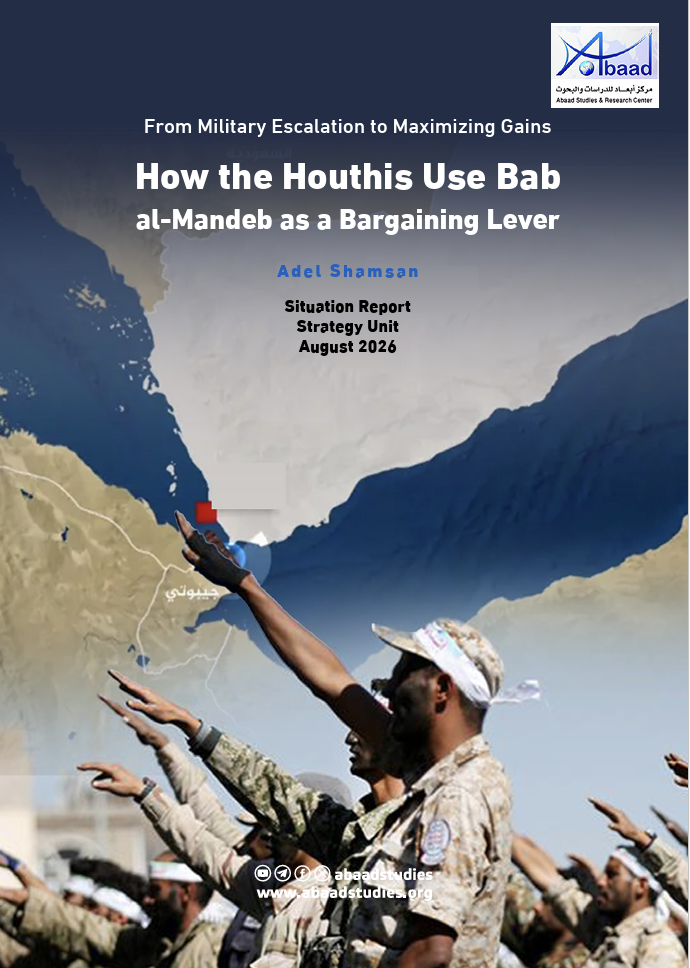
From Military Escalation to Maximizing Gains: How the Houthis Use Bab al-Mandeb as a Bargaining Lever
Executive Summary
This study presents an analytical reading of the Houthi militia’s shift from a model centered on direct military control to a more complex approach that uses military escalation and maritime threats to raise costs and maximize bargaining leverage. It argues that the impact of operations targeting international shipping in the Red Sea and the Bab al-Mandeb Strait cannot be understood solely in terms of territorial control, but also by their ability to generate economic and political pressure on regional and international actors. Such pressure may open pathways to negotiating or institutional gains, while Yemenis and the internationally recognized government bear a substantial share of the cost of this escalation.
The study draws on documented reports from international and specialized institutions. Key indicators include the decline in Suez Canal revenues from a record $10.25 billion in 2023 to about $3.99 billion in 2024, followed by an initial 29.3% recovery in the first half of FY2025/2026 [26]-[30]; the fall in oil flows through Bab al-Mandeb from about 8.6 million barrels per day in 2023 to between 4.1 and 4.2 million barrels per day during 2024 and the first half of 2025, followed by a partial recovery to 7.4 million barrels per day in June 2026 before that recovery was tested again by Houthi escalation in July-August 2026 [11]; a many-fold increase in maritime war-risk insurance premiums [21]-[25]; and UN Panel of Experts documentation of Houthi revenues from customs and fuel-related charges amounting to roughly $5.5 billion between 2022 and 2024 [33].
The study further shows that this pattern is not confined to the Red Sea. On 20 July 2026, the Houthis announced a maritime ban targeting vessels and shipping interests linked to Saudi Arabia, indicating a broadening of the threat from attacks on individual ships to an attempt to undermine confidence in regional commercial infrastructure and ports [1][3]. Maritime incidents then escalated: at least two attacks near Bab al-Mandeb on 6 August 2026 prompted international warnings, followed by a more violent attack on 11 August in which repeated missile strikes hit a vessel near the strait, killing and wounding members of its civilian crew [42][43][44].
In parallel, the escalation produced an unprecedented institutional regional response. On 30 July 2026, Saudi Arabia, with representatives of 43 states and organizations in attendance, announced the establishment of a Multinational Maritime Defense Coalition comprising 14 founding states, including the internationally recognized Yemeni government; a military commander was appointed on 6 August 2026 [45][46]. Despite this, the Houthis continued escalating through mid-August, claiming on 17 August to have targeted a Saudi military landing ship off Mocha and moving forces toward government-held areas around Al-Khawkhah and Mocha in an apparent effort to approach the shores of Bab al-Mandeb [68][69]. This study also includes a separate chapter documenting Yemen’s broader losses, explicitly distinguishing between figures promoted by the Houthis to defend their record and data documented by the legitimate government and independent international organizations.
The study concludes that this pattern cannot be countered by military action alone. It requires an integrated political-economic approach based on sustainably protecting international shipping lanes, disrupting the Houthis’ illicit financing, preventing security threats from being converted into political or financial gains, supporting Yemeni government institutions in restoring control over ports and resources, and linking any future settlement to ending the militarization of the economy rather than rewarding actors stand behind the escalation.
Introduction
Since the Houthi militia seized the capital, Sana’a, in 2014 and overthrew the state’s legitimate institutions, the Yemeni conflict has passed through multiple phases in which the militia’s tools and methods have varied. What has become clear, however, is that the military dimension alone no longer sufficiently explains its behavior. Since 2023, the Houthis have emerged as an actor capable of affecting global trade by threatening navigation in the Red Sea and the Bab al-Mandeb Strait, extending the impact of the conflict far beyond Yemen to the international economy, while the internationally recognized government continues its efforts to restore state institutions and sovereign resources.
This study starts from a central hypothesis: Houthi military escalation is no longer only an end in itself, but a potential tool for increasing bargaining leverage by raising the economic and security costs borne by regional and international actors concerned with maritime security. The study does not assume that every escalation automatically produces a gain; rather, it examines whether the costs imposed by the threat actually translate into concessions or political, financial, and institutional arrangements. This analysis has become more relevant in light of developments in the summer of 2026, when the Houthis expanded the scope of their threats to include vessels and interests linked to Saudi Arabia, then escalated attacks in early August 2026 to the point of causing deaths and injuries among civilian crews, alongside rising tensions with Iran over the use of Sana’a Airport [1][3].
However, the study seeks to answer a central question: Why is the military dimension alone no longer sufficient to understand the behavior of the Houthi militia? From this flow several subsidiary questions concerning the nature of the conflict economy, the role of Bab al-Mandeb as a strategic asset that can be used for bargaining, the mechanisms used to finance Houthi operations, the actual cost borne by Yemen, and the possible scenarios for the trajectory of the crisis.
Chapter One: Theoretical Framework
1.1 The Concept of Conflict Economy
The conflict economy refers to economic activities that emerge from and are sustained by prolonged armed conflict, in which violence itself becomes a source of income and advantage for an illegitimate armed actor rather than merely a cost it seeks to end. In Yemen, this pattern is clearly reflected in Houthi behavior: peace is not necessarily an overriding end-state for the movement, while a prolonged condition of neither war nor peace can provide a favorable environment for maximizing resources and influence at the expense of legitimate state institutions.
1.2 The Political Economy of War and the Conversion of Military Power into Political Influence
The political-economy literature on war shows that illegitimate armed actors often develop strategies to convert military capabilities into political leverage by creating persistent instability that other parties find difficult to bypass without direct negotiation. In this sense, the terrorist Houthi militia seeks to establish itself as an actor that cannot be excluded from future security, political, or economic arrangements despite lacking constitutional or electoral legitimacy and despite the existence of an internationally recognized government representing Yemen’s constitutional legitimacy.
1.3 Deterrence and Strategic Coercion
The study draws on analytical tools from theories of strategic coercion and coercive bargaining to explain the terrorist Houthis’ use of limited and intermittent violence as a means of pressure and bargaining rather than as a constant attempt to achieve comprehensive military victory. Recent analyses suggest that the Houthis use maritime attacks as a selective coercive instrument activated conditionally and in connection with broader cycles of political escalation, rather than as a permanent disruption mechanism, thereby preserving strategic value while avoiding the cost of a prolonged war of attrition [2].
Other analyses indicate that the Houthis retain a margin of strategic autonomy despite their heavy reliance on Iranian military, technical, and intelligence support. They use this support to advance their own objectives: consolidating unlawful security control over areas under their authority and strengthening their bargaining position vis-a-vis the legitimate government and the international community [2][40].
Chapter Two: The Evolution of terrorist Houthi Strategy
The shift of Houthi strategy can be traced through six overlapping phases, reflecting a gradual shift from direct military control toward the use of economic and maritime threats as bargaining pressure:
|
Phase |
Approximate Period |
Principal Feature |
|
Direct military control |
2014-2018 |
Seizure of legitimate state institutions and Sana’a by force, followed by military expansion. |
|
Consolidating influence and parallel governance |
2018-2022 |
Creation of unlawful parallel governing institutions and imposition of local levies and taxes. |
|
Truce and war economy |
April 2022-October 2023 |
Relative decline in operations alongside a major expansion of Houthi financing through customs and fees. |
|
Using international shipping as leverage |
November 2023-2025 |
Targeting commercial vessels in the Red Sea and Bab al-Mandeb and linking the campaign to the Gaza war. |
|
Expanding economic coercion |
July 2026 |
Maritime ban targeting vessels and interests linked to Saudi Arabia. |
|
Peak escalation and institutional regional response |
August 2026 |
Escalation of lethal attacks (6, 11 and 17 August), attempted ground advances toward Bab al-Mandeb, and formation of a Saudi-led regional maritime defense coalition in response. |
2.1 Direct Military Control (2014-2018)
During this phase, the Houthis relied on direct territorial expansion, the seizure of legitimate state institutions, and the appropriation of public resources in areas under their control, without a significant need for indirect economic pressure tools.
2.2 Consolidating Influence and Parallel Governance (2018-2022)
As military victory remained elusive and the legitimate government endured, the Houthis moved to construct unrecognized parallel governing institutions and impose an expanded system of local levies and taxes on populations under their control, enabling a degree of self-financing relatively independent of direct Iranian support.
2.3 Truce and War Economy (April 2022-October 2023)
This phase saw a relative decline in direct military operations alongside a major expansion in Houthi financing through customs duties and charges on fuel and imports. The UN Panel of Experts documented that the Houthis collected more than YER 270 billion from these sources during the truce alone [35], while the legitimate government was deprived of national oil and gas revenues as a result of Houthi attacks on export terminals.
2.4 Using International Shipping as Leverage (November 2023-2025)
Beginning in November 2023, the Houthis shifted to targeting commercial and military vessels in the Red Sea under the stated rationale of supporting Gaza. The target set gradually expanded from vessels the group linked to Israel, to those linked to the United States and the United Kingdom, and then to vessels associated with companies calling at Israeli ports, in a four-stage pattern of escalation documented in the sources [7].
2.5 Expanding the Scope of Economic Coercion (July 2026)
On 20 July 2026, the Houthi militia announced a maritime ban under which it claimed it would target vessels and interests linked to Saudi Arabia. For the first time in such explicit terms, the threat extended to non-Saudi vessels trading with Saudi Red Sea ports. This marked a shift from targeting individual ships toward targeting confidence in commercial infrastructure and regional ports themselves. Riyadh officially denied imposing any blockade on Yemen, while the Houthis continued to allege the existence of a “Saudi blockade” [1][3][42].
2.6 Peak Escalation and the Institutional Regional Response (August 2026)
Maritime incidents intensified in the first week of August 2026. On 6 August, maritime security sources reported at least two attacks near Bab al-Mandeb, coinciding with Houthi claims of attacks on two Saudi oil tankers that Riyadh did not confirm. On 11 August 2026, the Houthis carried out repeated missile attacks on a vessel near Bab al-Mandeb, causing a fire on board and killing several Pakistani and Indonesian civilian crew members while injuring others, including Yemeni Coast Guard personnel serving under the legitimate government who participated in the rescue operation [42][43][44].
In response, Riyadh hosted a security meeting on 30 July 2026 attended by chiefs of staff and representatives from 43 states and organizations. The meeting produced a joint announcement by 14 founding states - including the internationally recognized Yemeni government - launching the Saudi-led Multinational Maritime Defense Coalition. Saudi Arabia appointed a military commander for the coalition on 6 August 2026, marking the first coordinated institutional regional response of this scale since the start of the maritime threat wave [45][46]. Presidential Leadership Council Chairman Rashad al-Alimi welcomed the coalition, describing it as a strategic step to strengthen collective security and protect international sea lanes, and called on Yemeni political forces to unite in confronting Houthi escalation [66][67].
2.7 West Coast Escalation and Houthi Attempts to Advance Toward Bab al-Mandeb (17-20 August 2026)
The Houthis continued their escalation in mid-August 2026 across two interconnected fronts: international shipping and Yemen’s west coast. On 17 August, the group claimed it had targeted a Saudi military landing ship and four escort boats off Mocha. International media were unable to independently verify the claim, and Saudi authorities issued no immediate comment. The claim came days after the Houthis launched ballistic missiles at Mocha Port, which was later forced to halt operations, according to the internationally recognized Yemeni government [68][69].
At the same time, military field sources reported that the Houthis were redeploying and preparing for a large-scale military operation against government-held areas along the west coast, from Al-Khawkhah south of Hodeidah through Mocha and toward Bab al-Mandeb. According to a spokesperson for the government-aligned National Resistance Forces, the objective was to establish a Houthi foothold on the shores of the strait and create a situation resembling the Strait of Hormuz, where Iran exercises direct strategic control. Military sources also reported the failure of an earlier Houthi attempt to seize Zuqar Island, the largest Yemeni island in the Red Sea [69][70].
The Yemeni Presidential Leadership Council held the Houthis responsible for sinking an Indian cargo vessel in the Red Sea. In successive meetings, it also stressed the cohesion of legitimate state institutions and the unity of military decision-making in the face of Houthi escalation, rejecting what it described as Houthi “blackmail” through threats to international navigation in order to impose a fait accompli [71].
Chapter Three: Bab al-Mandeb as an Economic and Strategic Asset
Bab al-Mandeb is one of the world’s most important maritime chokepoints, linking the Red Sea to the Gulf of Aden and the Arabian Sea. At its narrowest point it is only about 29 kilometers wide, concentrating shipping into two navigational channels each roughly 3 kilometers wide [9].
3.1 Bab al-Mandeb’s Share of Global Trade
Under normal conditions, an estimated 12-14% of global maritime trade and roughly one quarter of global container traffic pass through the strait [11][13].
Oil and petroleum-product flows through the strait reached about 8.6 million barrels per day in 2023, equivalent to roughly 9% of global seaborne oil trade [9][12].
The strait is also a major route for liquefied natural gas (LNG) shipments moving from the Gulf to Europe and Asia; these flows declined sharply as Houthi attacks intensified [16].
3.2 Impact of Maritime Disruption on Energy Flows
Oil flows through Bab al-Mandeb fell from 8.6 million barrels per day in 2023 to about 4.1-4.2 million barrels per day during 2024 and the first half of 2025 - a decline of more than 50% - before partially recovering to around 7.4 million barrels per day in June 2026 as Saudi Arabia redirected part of its exports through Red Sea ports [11]. Houthi escalation in July and August 2026 then tested this fragile recovery. Tracking data cited by Reuters showed the number of vessels transiting the strait falling from 28 on one day to just one on another day in early August, alongside Houthi claims that it had targeted two Saudi oil tankers, claims Riyadh did not confirm [47][48].
3.3 From Maritime Chokepoint to Bargaining Asset
The Houthis’ effective control over parts of Yemen’s western coastline overlooking Bab al-Mandeb - a consequence of their armed seizure of power from the legitimate government - gives them a geographic position from which they can influence one of the world’s most critical maritime corridors. Geography alone, however, does not automatically produce bargaining gains. The value of this position depends on the Houthis’ ability to sustain a credible threat, the scale of the costs it imposes, and the response of regional and international actors. Bab al-Mandeb thus becomes a strategic asset that can be leveraged in future negotiations, whether with Riyadh or the wider international community [1].

Chapter Four: The Escalation Economy - From Threats to Gains
This study interprets Houthi behavior through what may be termed the “escalation economy cycle,” as an analytical model rather than an inevitable causal chain. The cycle begins with a limited military operation or a threat to navigation. If its effects widen, they are transmitted into risk assessments, insurance, shipping routes, and trade costs, before generating political pressure that may open negotiating channels. Political or financial gains are not automatic; they require demonstrable, traceable evidence linking escalation to an actual change in the behavior of other actors.

Under this model, an operation targeting navigation or threatening Red Sea security is not purely military. It may also raise the cost of the crisis for the global economy and increase the Houthis’ salience in the calculations of actors concerned with maritime security. Yet higher costs alone do not prove the success of coercive strategy. A distinction must be maintained between the ability to inflict damage and the ability to convert that damage into a political concession, security arrangement, or bargaining gain at the expense of Yemen’s constitutional legitimacy.
In this context, negotiations with the Houthis do not necessarily mark the end of the conflict; they may instead represent its continuation by other means. Military leverage can be translated into political demands and institutional arrangements, and potentially into economic gains or reduced pressure and sanctions. Whether such outcomes materialize, however, depends on the response of other actors. This helps explain why continued escalation can at times coexist with calls for de-escalation as an attempt to improve the terms of a future settlement [1][4].
Chapter Five: Data Analysis
5.1 Decreasing Suez Canal Revenues and Signs of Recovery
The Suez Canal is one of the clearest quantitative indicators of the regional costs associated with the Red Sea crisis. Revenues reached a record $10.25 billion in 2023 before falling by 61% to about $3.99 billion in 2024 and to around $3.6 billion in FY2024/2025 (a 45.5% decline). Egypt’s president estimated the canal’s cumulative losses since the beginning of the decade at roughly $10 billion [26]-[30]. These losses, however, cannot be attributed exclusively to a single factor; they reflect the interaction of Red Sea risks, shipping companies’ routing decisions, and wider market dynamics. Data for the first half of FY2025/2026 showed an initial 29.3% recovery compared with the same period a year earlier, supported by additional maritime services introduced by the Suez Canal Authority [49][50].

5.2 Rising Maritime War-Risk Insurance Premiums
War-risk insurance premiums for vessels transiting the Red Sea rose from a near-symbolic level of no more than 0.07% of vessel value in October 2023 to between 0.7% and 1% in early 2024, reaching 2% in some cases involving U.S.- or Israel-linked vessels - an increase of more than 2,700% over original levels [21][22]. Following the Houthis’ announcement of a maritime ban against Saudi Arabia on 20 July 2026, premiums rose again to around 0.75% of vessel value [24].

5.3 Additional Indicators of Maritime Disruption (UNCTAD)
UNCTAD data show that ship tonnage transiting the Gulf of Aden fell by 76%, while tonnage transiting the Suez Canal declined by 70% by mid-2024. At the same time, arrivals via the Cape of Good Hope rose by 89%, and freight rates on the Shanghai-Europe route increased by more than 256% at the height of the crisis in early 2024 [17][15]. These indicators confirm a clear economic cost from maritime disruption, but do not by themselves prove that this cost translated into direct political gains for the Houthis.

5.4 August 2026 Escalation and Regional Response: Short-Term Indicators
Tracking data cited by Reuters on 2 August 2026 showed the number of vessels crossing Bab al-Mandeb falling from 28 on Friday to 18 on Sunday. On 6 August, Reuters cited Kpler data showing a sharper one-day fall to one vessel, compared with 20 the previous day, amid Houthi claims of attacks on two Saudi oil tankers that Riyadh did not confirm [47][48]. The Houthi attack on 11 August 2026, which killed and wounded civilian crew members, formed part of an escalating pattern of attacks on civilian shipping [42][43][44]. These figures are highly event-sensitive snapshots and should not be generalized into a long-term trend without a broader time series. In parallel, the establishment of the Saudi-led Multinational Maritime Defense Coalition on 30 July 2026 and the appointment of its commander on 6 August represented the first coordinated regional institutional response of this scale since the maritime threat wave began [45][46].
Chapter Six: War Economy - Sources of Terrorist Houthi Financing
The UN Panel of Experts on Yemen, alongside specialized Yemeni and international sources, documents the Houthis’ continued diversification of illicit financing despite international sanctions. The system combines levies, customs duties, and smuggling, all of which impose costs on populations under Houthi control and on Yemen’s national economy:

|
Source of Financing |
Documented Estimate |
Source |
|
Total proceeds from charges on fuel imports (2022-2024), including unofficial fees and profit margins |
≈ $5.5 billion (about YER 1.34 trillion) |
UN Panel of Experts [33] |
|
Official customs duties on fuel imports only (2022-2024) |
≈ $4 billion |
UN Panel of Experts [36] |
|
Tax and customs revenues through Hodeida, Al-Salif and Ras Isa ports (May 2023-June 2024) |
$789 million |
Stolen Asset Recovery Initiative (SARI) [34] |
|
Revenues collected during the truce from oil, taxes, and various fees |
More than YER 270 billion |
UN Panel of Experts [35] |
|
Additional U.S. sanctions on Houthi financing and smuggling networks (January 2026) |
21 individuals, entities, and vessels in Yemen, Oman, and the UAE targeted |
U.S. Department of the Treasury [51] |
Beyond direct levies, the Panel of Experts’ October 2025 report points to continued Houthi violations of the arms embargo through smuggling networks that use diverse routes and methods. The legitimate Yemeni authorities seized more than 750 tons of weapons and illicit materials bound for the Houthis in June 2025 alone, indicating that smuggling functions both as a financing channel and as a means of strengthening the group’s combat capabilities [38][39].
Chapter Seven: Yemen’s Comprehensive Losses - Houthi Claims versus Data from the Legitimate Government and International Organizations
This study explicitly distinguishes between two levels of information: (1) figures and claims promoted by the Houthi militia as part of its political narrative; and (2) data documented by the internationally recognized Yemeni government and its institutions, together with the United Nations, its agencies, and independent international human-rights organizations. The second level is used as the primary basis for assessing costs, while recognizing that some government data must also be read in the context of its source and time period and that heterogeneous indicators should not be combined into a single figure without a unified accounting basis.
|
Scenario |
Description |
Supporting Indicators |
|
1. Continued and widening escalation |
The group continues to use and broaden the maritime threat to include additional regional actors, as occurred with Saudi Arabia in July 2026. |
Declared maritime ban against Saudi Arabia; rising tensions with Iran over Sana’a Airport [1] [3] |
|
2. Partial political settlement |
De-escalation arrangements in return for political or financial gains for the group, similar to the Saudi-Houthi negotiating track suspended in late 2023. |
Multiple negotiating precedents; declared regional desire to avoid broader escalation [1] [4] |
|
3. Coordinated international containment |
Intensified international efforts to protect navigation through maritime-security coalitions, alongside stricter enforcement of financial sanctions. |
Operation Prosperity Guardian; expanded U.S. sanctions on fuel-financing networks [7] [33] |
|
4. Regional expansion of the conflict |
Extension of tensions to additional regional actors (Iran and armed groups in the Horn of Africa), turning the Red Sea into a broader confrontation arena. |
Reports of Houthi coordination with armed groups in the Horn of Africa; Iranian escalation over Sana’a Airport [41] |
7.1 Houthi Claims: Propaganda Figures Used to Defend the Group’s Record
In a report issued in early August 2026, the Houthis promoted an estimate of losses “exceeding $1.13 trillion” from what they described as “war and blockade,” assigning full responsibility to external actors. Independent Yemeni economists and researchers described the figure as an overt attempt to recast responsibility for economic collapse and evade the consequences of the Houthis’ armed seizure of legitimate state institutions. They noted that the report mixes direct, indirect, incorrect, and future losses with claimed compensation estimates - contrary to basic standards of economic reporting - while omitting the substantial revenues the Houthis themselves collected through customs, taxes, and confiscation of citizens’ and companies’ property [52]. This study therefore treats these figures as Houthi propaganda claims rather than confirmed facts.
7.2 Legitimate Government Reports: Direct Economic Costs
- Oil export suspension: Houthi attacks on export terminals controlled by the legitimate government - Al-Dhabba in Hadramawt and Al-Nashima in Shabwa - have led to a near-total halt in crude oil exports since October 2022, depriving the government budget of its principal revenue source. The governor of the Central Bank of Yemen, which is aligned with the legitimate government, estimated direct losses at more than $6 billion by the end of 2024; later estimates approached $7.5 billion as the suspension extended to nearly four years, depriving the legitimate government of more than 70% of its own-source revenue [53][54].
- Currency division: Houthi monetary policies - most notably the prohibition on circulating new banknotes issued by the Central Bank of Yemen in Aden within Houthi-controlled areas since 2016 - created two parallel exchange rates that diverged sharply. By mid-2026, the rate was roughly YER 530-540 per U.S. dollar in Houthi-held areas versus around YER 1,550-1,580 in government-held areas, a gap of almost threefold. Government officials said this divergence compounded hardship in government-held areas and pushed poverty rates there above 80% [55][56].
- Continued unlawful levies: The UN Panel of Experts documented Houthi collection of around YER 994 billion in customs charges on fuel alone between April 2022 and June 2024, while estimating total income from the sector - including unlawful fees - at roughly YER 1.34 trillion. This came alongside confiscation of private property and levies on companies and citizens that drove thousands of businesses to close or relocate outside Houthi-controlled areas [33][52].
7.3 United Nations and International Organization Reports: Human and Humanitarian Costs
- One of the world’s largest humanitarian crises: Around 22.3 million Yemenis are estimated to need humanitarian assistance and protection services in 2026, including about 18.3 million people facing acute food insecurity and more than 2.2 million children under five suffering acute malnutrition. Yemen is also the world’s fifth-largest internal displacement crisis, with around 5.2 million internally displaced people. The most severe conditions are concentrated in Houthi-controlled areas, where food assistance is at times used as a tool of coercive political loyalty [57][58][59].
- Grave violations against children: The UN Secretary-General’s report on children and armed conflict documented 742 grave violations against 652 children in Yemen in 2025, a 27.3% increase over 2024. Violations included killing and maiming, recruitment, sexual violence, and attacks on schools and hospitals, with the Houthis held responsible for a significant share, including child recruitment and the use of children in military activities. Yemen’s National Committee for Children’s Affairs also documented 3,816 children killed or wounded since 2016, 1,368 cases of child recruitment, and 708 child casualties from mines laid by the Houthis [60][61][62].
- Detention of UN and humanitarian personnel: Since the arrest campaign launched by the Houthis on 31 May 2024, approximately 73 UN employees and dozens of other humanitarian workers remained arbitrarily detained as of February 2026. A World Food Programme employee died in Houthi detention in February 2025. In June 2026, the UN Security Council renewed its strong condemnation of these detentions and demanded the immediate and unconditional release of all detainees [63][64][65].
- Civilian casualties from maritime escalation: The Houthi attack of 11 August 2026 alone killed and wounded a number of Yemeni and Asian seafarers. Earlier attacks also caused serious damage to Yemeni ports, including Mocha Port, underscoring that Yemenis working in maritime and coastal sectors bear a major share of the human cost of Houthi maritime escalation [43][44].
Methodological note: The figures in this chapter are drawn from the legitimate government and its institutions, the United Nations and its agencies, and independent international human-rights organizations, and they cover different periods. They should therefore not be mechanically added into a single aggregate figure, but read as complementary indicators of the scale of the cost. Differences in sources, periods, and accounting definitions also require a distinction between documented figures and estimates, and between temporal correlation and direct causation.
Chapter Eight: Future Scenarios
|
Scenario |
Description |
Supporting Indicators |
|
1. Continued and widening Houthi escalation |
The Houthis continue using and expanding the maritime threat to include additional regional actors, as they did with Saudi Arabia in July 2026 and escalated further in August. |
Declared maritime ban against Saudi Arabia; lethal 11 August attack; rising tensions with Iran over Sana’a Airport [1][3][42] |
|
2. Partial political settlement |
The Houthis scale back part of their threats in return for political or financial gains, similar to the Saudi-Houthi negotiating track suspended in late 2023. |
Multiple negotiating precedents; declared regional desire to avoid wider escalation [1][4] |
|
3. Coordinated international and regional containment |
Operational activation of the Multinational Maritime Defense Coalition, intensified international efforts to protect navigation, and stricter enforcement of financial sanctions on the Houthis. |
Coalition established on 30 July and commander appointed on 6 August; expanded U.S. sanctions on Houthi financing networks [45][46][51] |
|
4. Regional expansion of the conflict |
Houthi escalation extends to additional regional actors (Iran and armed groups in the Horn of Africa), turning the Red Sea into a wider confrontation arena. |
Reports of Houthi coordination with armed groups in the Horn of Africa; Iranian escalation over Sana’a Airport [41] |
A reading of the available indicators as of 20 August 2026 suggests that Scenario One - continued and widening Houthi escalation - remains the most consistent with short-term indicators, alongside a gradual activation of Scenario Three - coordinated international containment - following the establishment of the maritime defense coalition. Scenario Two - a partial political settlement - remains contingent on the Houthis’ willingness to make genuine, measurable concessions, while Scenario Four depends on a tangible expansion of the conflict to additional arenas or regional actors.
Recommendations
First: For the Legitimate Yemeni Government
- Accelerate efforts to restore control over major ports and entry points from the Houthi militia, while strengthening transparency in the management of sovereign resources as a credible alternative to the unlawful levies imposed by the group.
- Build institutional capacity to document the economic and information-related effects of Houthi escalation and present them regularly to the international community on the basis of verified information, in order to counter the narratives promoted by the group.
- Work to address monetary division between Houthi-controlled and government-held areas in coordination with the International Monetary Fund and international donors.
Second: For the Gulf States
- Tie any future negotiating track with the Houthis to clear benchmarks that prevent escalation from being converted into a recurring mechanism for extracting gains.
- Strengthen joint maritime security coordination - particularly through the Multinational Maritime Defense Coalition - to protect ports and coastal facilities against the Houthis’ expanding threats.
Third: For the United States
- Continue tightening sanctions on fuel-financing and smuggling networks linked to the Houthi militia while improving enforcement mechanisms.
- Support sustained operations to protect international navigation rather than limiting responses to immediate reactions to Houthi attacks.
Fourth: For the European Union
- Expand participation in European maritime-security missions in the Red Sea in ways that reduce dependence on any single actor.
- Support economic-recovery programs for Yemen and for countries such as Egypt that have been directly affected by the decline in Suez Canal revenues amid Houthi escalation.
Fifth: For the United Nations
- Strengthen the mandate and capacity of the UN Panel of Experts on Yemen to track Houthi financing and smuggling networks and update its findings more frequently.
- Tie any UN de-escalation initiative to clear benchmarks for ending the militarization of Yemen’s economy and halting unlawful Houthi levies, rather than settling for a temporary pause in operations.
- Maintain sustained pressure for the immediate and unconditional release of all UN personnel and humanitarian workers detained by the Houthis.
Conclusion
The Yemeni experience shows that the conflict is no longer merely a conventional military confrontation, but an advanced example of the interaction between the conflict economy and instruments of coercion and political pressure. The concept of an “escalation economy” helps explain how limited violence and maritime threats can be used to raise the cost of the crisis and attempt to convert that cost into bargaining value. Yet the data do not support the assumption that every escalation automatically produces a gain; the strategic outcome depends on whether pressure actually yields concessions or political and financial arrangements, or is instead met by sanctions, military responses, and counter-coalitions.
Most importantly, Yemenis themselves and the legitimate government bear the heaviest burden: a shattered economy, a divided currency, oil exports halted for years after Houthi attacks on export infrastructure, children recruited, killed, or maimed, and aid workers detained in a country where more than 22 million people require humanitarian assistance. As this study documents, the figures promoted by the Houthis to portray themselves as victims do not withstand comparison with reports from the legitimate government and independent international organizations.
Without an integrated response to the economic dimension of the conflict and a clear system for documenting claims and facts at defined levels of confidence, military and maritime escalation will continue to impose broad costs on Yemen and the wider region. The priority is to prevent those costs from being converted into durable political or financial gains by protecting navigation, disrupting financing networks, supporting state institutions, and linking any future settlement to measurable commitments that end the militarization of the economy and limit the reproduction of instruments of escalation.

Adel Shamsan
Researcher on Yemeni and Political Affairs
References
[1] Chatham House, "The Houthi Red Sea blockade: Will collective maritime security be defended, or break down?", 24 Jul 2026.
[2] Horn Review, "The Red Sea, Maritime Coercion and Regional Escalation Dynamics", 2026.
[3] Horn Review, "The Expanding Houthi Threat: Strategic Infrastructure and Energy Security in the Red Sea", 2026.
[4] CSIS, "A Strategic Approach to Red Sea Security", 2025.
[5] International Crisis Group, "Red Sea: Calming the Waters", Report No. 248, 2025.
[6] Wilson Center, "Timeline: Houthi Attacks".
[7] The Washington Institute, "Houthi Shipping Attacks: Patterns and Expectations for 2025", 2024.
[8] House of Commons Library, "UK and international response to Houthis in the Red Sea 2024/25".
[9] U.S. Energy Information Administration (EIA), "The Bab el-Mandeb Strait is a strategic route for oil and natural gas shipments".
[10] Rystad Energy, "Chokepoints under pressure: The fragile lifelines of global energy", 2026.
[11] The National, "Middle East energy routes explained: The chokepoints and pipelines shaping oil trade", 2026.
[12] Coface, "Bab el-Mandeb Strait: chokepoint threatens global trade", 2025.
[13] The Conversation, "Why a second global shipping chokepoint could soon live up to its name as the 'Gate of Tears'", 2026.
[14] Anadolu Agency, "Around 70% of global oil demand transported through strategic maritime chokepoints".
[15] UNCTAD, "Navigating Troubled Waters: Impact to Global Trade of Disruption of Shipping Routes in the Red Sea, Black Sea and Panama Canal", Feb 2024.
[16] UNCTAD, "Red Sea Crisis and implications for trade facilitation in Africa", 2024.
[17] UNCTAD, "Review of Maritime Transport 2024".
[18] UNCTAD, "Unprecedented shipping disruptions raise risk to global trade", 2024.
[19] UNCTAD, "Stormy seas for global shipping: UNCTAD warns of uncertainty, volatility and rising costs", 2025.
[20] UNCTAD (Jan Hoffmann), cited in AllAfrica, "The Red Sea Shipping Crisis Is Having a 'Dramatic' Impact", Jan 2024.
[21] AGBI, "Cost of Red Sea shipping insurance rises 2,700%", Feb 2024.
[22] Policyholder Pulse, "Red Sea Dangers: Increasing Insurance Premiums...", Feb 2024.
[23] ASIS International, "War Risk Insurance Market Grows Amid Global Volatility", 2025.
[24] Yemen Monitor, "Surge in Red Sea War Risk Insurance Costs Following Houthi Announcement", 2026.
[25] Reuters, "Red Sea insurance rates to stay firm as US airstrikes raise fears for ships".
[26] Egypt Today, "Egypt's Suez Canal revenues go down by 61% to $3.9 billion in 2024 due to Red Sea tensions", Apr 2025.
[27] Africanews / Arab News, "Egypt's revenue from the Suez Canal plunged sharply in 2024", Apr 2025.
[28] Middle East Eye, "Suez Canal revenues plunge by 60 percent...", Dec 2024.
[29] Amwal Al Ghad (Central Bank of Egypt), "Suez Canal revenues drop 45.5% in FY 2024/2025", Oct 2025.
[30] MEXC News, "Suez Canal revenue down $10bn due to regional conflicts", Mar 2026.
[31] Daily News Egypt, "Egypt Loses $7 Billion of Suez Canal Revenues...", Dec 2024.
[32] Sana'a Center for Strategic Studies, "The Yemen Review — The Economy", Q4 2025.
[33] FDD's Long War Journal, "Treasury targets Houthi oil revenue...", Jul 2025.
[34] Sana'a Center for Strategic Studies, "The Yemen Review — The Economy", Apr–Jun 2025 (citing SARI).
[35] Asharq Al-Awsat (English), "UN Experts Condemn Yemen's Houthis for Hampering Aid Delivery", 2023.
[36] Global Trade Review (GTR), "Houthis raising billions of dollars from illicit fuel imports, UN says", Nov 2024.
[37] The Washington Institute, "In Damning Report, UN Panel Details War Economy in Yemen".
[38] HRITC, summary of UN Security Council document S/2025/650, Nov 2025.
[39] UN Security Council, Panel of Experts on Yemen, S/2025/650, 15 Oct 2025.
[40] NESA Center for Strategic Studies, "CSAG Strategy Paper: Yemen after the KSA–Iran Agreement", Feb 2024.
[41] ACLED, "Regional power struggles fuel simmering tensions across the Red Sea".
[42] CNN Arabic, “After Two Attacks Near Bab al-Mandeb, Warnings of Escalation Threatening Navigation in the Red Sea,” 6 Aug 2026.
[43] CNN Arabic, “Amid Uncertainty Over Its Identity, Fatalities After a Houthi Attack on a Vessel in Bab al-Mandeb,” 11 Aug 2026.
[44] Asharq Al-Awsat / Al-Mal News, “16 Killed and Wounded in Houthi Attack on a Vessel in Bab al-Mandeb,” 12 Aug 2026.
[45] Al Jazeera Encyclopedia, “Saudi-Led Maritime Defense Coalition to Protect Sea Lanes,” 7 Aug 2026.
[46] Ean Libya / Asharq Al-Awsat, “The New Maritime Coalition: Who Leads It and Which Countries Are Participating?”, 7 Aug 2026 (commander appointed 6 Aug 2026).
[47] Reuters, "Two tankers with Saudi oil exit Red Sea over weekend, data shows", 2 Aug 2026.
[48] Reuters, "Gulf shipping traffic down after Houthis say they attacked Saudi tanker", 6 Aug 2026.
[49] Suez Canal Authority, statements by Chairman Osama Rabie on H1 FY2025/2026 navigation and revenue recovery, Jul–Aug 2026.
[50] Al-Dostor, “EGP 122.5 Billion in Suez Canal Revenues in the First Half of 2026,” Aug 2026.
[51] U.S. Department of the Treasury, "Treasury Increases Pressure on Houthi Smuggling and Illicit Revenue Generation Networks", 16 Jan 2026.
[52] Asharq Al-Awsat, “Houthis Promote Trillion-Dollar Figures to Defend Their Coup Record,” 6 Aug 2026.
[53] Anadolu Agency (AA), “Yemen: We Lost $6 Billion Due to the Halt in Oil Exports Over Two Years,” Oct 2024 (follow-up 2026).
[54] Al-Araby Al-Jadeed / Al Jazeera, coverage of the suspension of Yemeni oil exports and its economic impact, updates 2024-2026.
[55] Yemen Monitor, “Yemeni Rial Continues to Fall in Aden Amid Relative Stability in Sana’a,” 6 Jul 2026.
[56] Al Jazeera, “After Two Years, How Has the Halt in Oil Exports Affected Yemen’s Economy?”, Oct 2024.
[57] UN OCHA, Yemen Humanitarian Response Plan 2026 launch, 18 Mar 2026.
[58] World Food Programme (WFP) Yemen, IDP food security monitoring report, Q1 2026.
[59] Al Jazeera, “United Nations: 18 Million Yemenis Face the Risk of Famine,” 19 Apr 2026.
[60] UN Secretary-General, Annual report on Children and Armed Conflict, Yemen chapter (2025), Jun 2026.
[61] National Committee to Address Issues Related to Recruitment and Use of Children in Yemen; UNICEF partnership, 21 Nov 2025.
[62] Human Rights Watch, World Report 2026 — Yemen chapter, Feb 2026.
[63] UN News (Arabic), “Security Council Members Renew Condemnation of Houthi Detention of UN Personnel,” 5 Jun 2026.
[64] Al-Watan (Saudi Arabia), “How the Houthis Turned Humanitarian Work into a Tool of Blackmail,” Aug 2026.
[65] Yemen Monitor, “International Organizations Call on the Houthis to Release UN Personnel,” 7 Jun 2026.
[66] Al-Dostor, “Yemen: Multinational Maritime Coalition Is a Highly Important Step to Strengthen Collective Security,” Aug 2026.
[67] Ejaz Network, “Presidential Leadership Council Chairman Welcomes the Multinational Maritime Coalition and Saudi Support,” 31 Jul 2026.
[68] CNN Arabic, “Houthis Claim They Targeted a Saudi Military Vessel in the Red Sea,” 17 Aug 2026.
[69] Euronews Arabic, “Houthi Movements Raise Concern: Is the Group Seeking to Control Bab al-Mandeb?”, 19 Aug 2026.
[70] Al-Sadara News, “Houthi Movements in the Red Sea: What Is Happening Between Hormuz and Bab al-Mandeb?”, 17 Aug 2026.
[71] Yemen Monitor, “Yemen’s Presidential Leadership Council Reaffirms Unity of the Council and Military Decision-Making and Holds the Houthis Responsible for Sinking an Indian Vessel,” Aug 2026.