





Abaad Center Releases Five Research Publications on Yemen and Red Sea Security in September
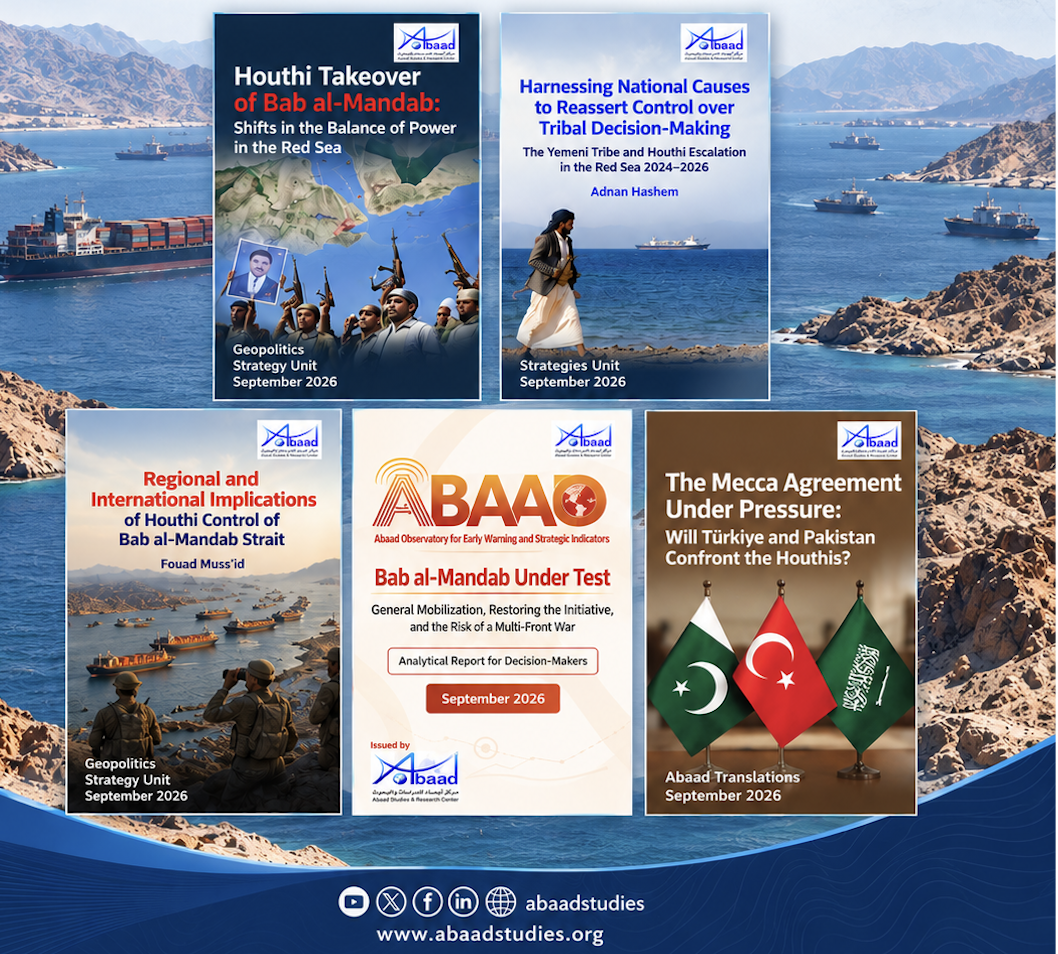
Abaad Studies & Research Center produced five research and analytical publications as part of its research activities covering September 2026, focusing on Yemen’s military and political developments, Red Sea security, the strategic significance of Bab al-Mandab, and the changing role of tribal structures in the country's prolonged conflict.
The research output also included the launch of the Abaad Observatory for Early Warning and Strategic Indicators (ABAAO) and a collection of translated international analyses examining regional responses to the escalation in Yemen and the Red Sea.
The publications reflect the center’s efforts to examine the changing dynamics of Yemen’s conflict, assess their regional and international implications, and provide policymakers, researchers, and stakeholders with strategic analysis and early-warning assessments.
Strategic Studies on Bab al-Mandab and the Red Sea
Two major studies examined the military and geopolitical implications of Houthi advances along Yemen’s western coast and their consequences for the balance of power in the Red Sea.
The first, titled “Houthi Takeover of Bab al-Mandab: Shifts in the Balance of Power in the Red Sea,” analyzed how the Houthis’ September advances into Mocha, Dhubab, and Mayyun Island changed the strategic environment around one of the world’s most important maritime corridors.
The study assessed the Houthis’ ability to translate territorial gains into lasting political and maritime influence, emphasizing that control of coastal areas and islands does not necessarily amount to complete control over the strait or the ability to maintain a prolonged maritime blockade.
It also examined the weaknesses that contributed to the retreat of government forces and warned of potential international arrangements that could protect selected shipping interests while leaving Yemen’s underlying conflict unresolved.
A second study, “Regional and International Implications of Houthi Control of Bab al-Mandab Strait,” by researcher Fouad Muss’id, explored the wider consequences of the military developments for regional security, international navigation, and global trade.
The research focused on Iran’s strategy in the Red Sea and the relationship between Bab al-Mandab and the Strait of Hormuz as two strategically significant maritime chokepoints.
It also addressed the potential impact of escalating tensions on shipping and insurance costs, international supply chains, and the growing militarization of vital maritime routes.
Research on Yemen’s Tribal Structures
In another major publication, Abaad released the second part of its 2026 book series, authored by researcher Adnan Hashem, under the title “Harnessing National Causes to Reassert Control over Tribal Decision-Making: The Yemeni Tribe and Houthi Escalation in the Red Sea 2024–2026.”
The study examined the impact of the Red Sea conflict on Yemen’s tribal structures and how the Houthis have used national and religious causes to mobilize tribal communities and influence their political decision-making.
Drawing on research materials in Arabic, English, Persian, French, and German, the study analyzed tribal responses, ideological mobilization, and the longer-term implications for traditional leadership and social cohesion.
It concluded that while the Houthis achieved tactical gains in mobilizing tribes through ideologically driven militarization, these efforts could generate deeper structural divisions and reshape tribal allegiances in the post-conflict period.
Launch of Abaad’s Early Warning Observatory
September also marked an important development in Abaad’s institutional research programs with the launch of the Abaad Observatory for Early Warning and Strategic Indicators (ABAAO).
The observatory is designed to transform daily monitoring of political, military, economic, security, humanitarian, and social developments into structured indicators and strategic assessments for decision-makers.
As part of this initiative, the observatory issued its September analytical report, “Bab al-Mandab Under Test: General Mobilization, Regaining the Initiative, and the Risk of a Multi-Front War.”
Based on monitoring conducted between September 1 and 30, the report identified an increasingly dangerous security environment in Yemen, with Bab al-Mandab emerging as a central focus of the conflict.
It placed the overall risk level at Red/Critical, citing the convergence of military escalation, threats to maritime security, national mobilization, and worsening humanitarian conditions.
The observatory incorporates AI-assisted tools to organize information, identify patterns, and classify emerging indicators, while maintaining human oversight and editorial responsibility for its final assessments.
Translations and International Perspectives
Abaad’s research activities also included a collection of translated international articles and analyses titled “Mecca Agreement Under Pressure: Will Türkiye and Pakistan Confront the Houthis?”
The collection examined international assessments of the Red Sea escalation, the security implications for Saudi Arabia, and the possible roles of Türkiye and Pakistan in responding to emerging regional threats.
The translated materials also covered Iranian military technology, Houthi battlefield developments, European security involvement, and the growing risks facing African states bordering the Red Sea.
Through its translation program, Abaad aims to make international reporting and analytical perspectives accessible to Arabic-speaking researchers, policymakers, and audiences interested in Yemen and regional security.
Strengthening Strategic Research and Policy Analysis
Together, the five publications reflect Abaad’s research priorities across four interconnected areas: military and geopolitical developments, Yemen’s political and social structures, early warning and strategic forecasting, and international analysis.
The center’s September research highlighted the increasingly close relationship between Yemen’s domestic conflict and broader regional security dynamics, particularly maritime navigation, economic stability, and the strategic competition surrounding the Red Sea.
Established in 2010, Abaad Studies & Research Center is an independent Yemeni research institution focusing on political, security, economic, and social issues. Through its studies, strategic assessments, monitoring programs, and translations, the center seeks to contribute to informed policy discussions and a deeper understanding of developments in Yemen and the wider region.