





Introduction
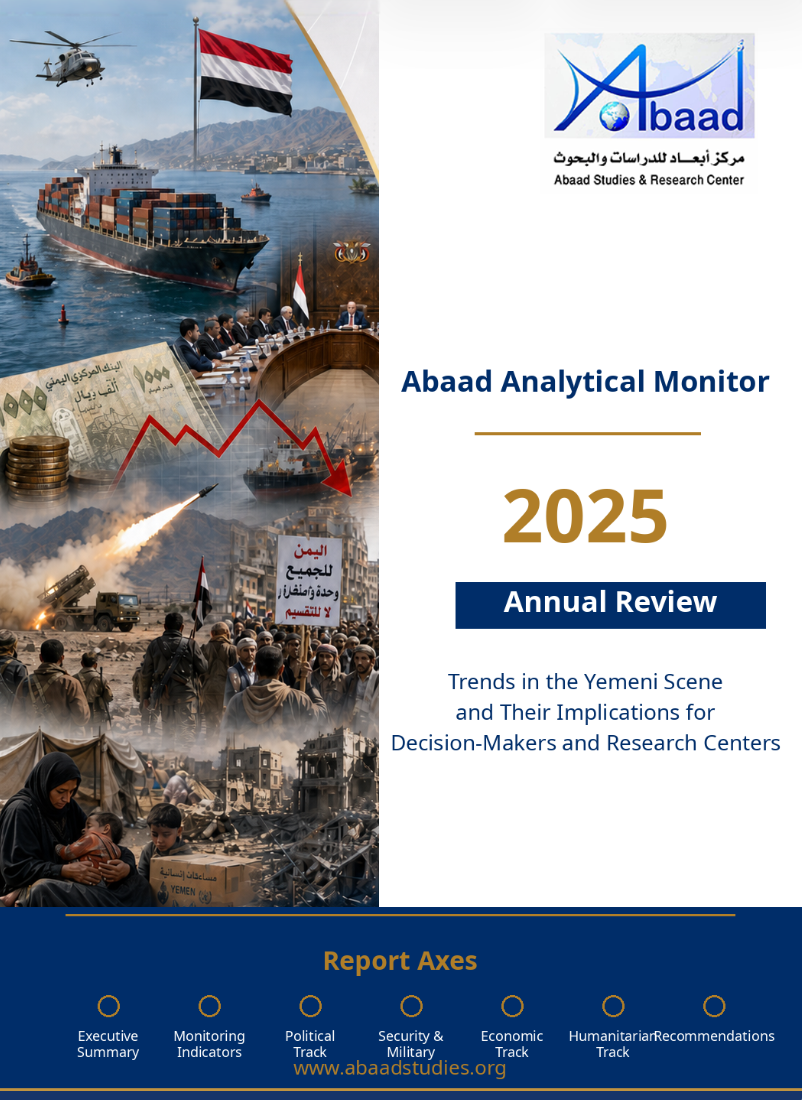
This report presents an analytical summary of the monthly monitoring trends of events in Yemen during 2025, based on twelve monthly files issued by Abaad Monitor. This annual review does not merely restate the events as they appeared in the monitoring files; rather, it seeks to read the overall trajectory of developments, identify major shifts, monitor the most prominent actors, and extract the political, security, economic, and humanitarian implications that can benefit decision-makers and research centers.
The year 2025 was dense with transformations. It began with escalating pressure on the Houthi group following its designation on the list of terrorist organizations, then moved into a phase of U.S. strikes and tensions in the Red Sea, before the economic crisis moved to the forefront of the scene. Later, the internal crises of legitimacy, Hadramout, Al-Mahra, and the Southern Transitional Council deepened, reaching a political and security peak in December with discussions of the UAE’s withdrawal from Yemen and the declaration of a state of emergency.
Executive Summary
2025 was the year in which the Yemeni crisis shifted from confrontation with the Houthis to a crisis of the state itself
The monthly monitoring showed that confronting the Houthis remained the main headline at the beginning of the year, especially with the group’s designation on the terrorism list and the growing discussion about leveraging international shifts to end the coup. However, the final months, particularly November and December, revealed that the challenge was no longer confined to the Houthis. It had extended to the crisis of legitimacy, the multiplicity of decision-making centers, the escalation of unilateral measures, tensions in Hadramout and Al-Mahra, and clashes of influence within the anti-Houthi camp.
The year 2025 shows that Yemen moved from a phase focused on pressuring the Houthis to a broader and more complex phase, defined by the question: Who will protect the Yemeni state from fragmentation?
In the first quarter, international shifts, particularly the terrorist designation and U.S. strikes, seemed to open a window for weakening the Houthis. However, subsequent developments showed that the Houthis remained capable of survival, and that the lack of unity within the anti-Houthi camp reduced the impact of these pressures.
By mid-year, the economic crisis had advanced as the government’s most important challenge, revealing that legitimacy cannot build a strong political position without economic and service-delivery capacity. In the final quarter, the crisis shifted from being about the Houthis alone to becoming a deep internal crisis within the structure of legitimacy, particularly in Hadramout, Al-Mahra, and Aden.
Accordingly, the greatest risk revealed by the 2025 monitoring was not only the continued presence of the Houthis, but the convergence of three risks at the same time:
-
Armed Houthis backed regionally.
-
A divided legitimacy burdened by an economic crisis.
-
Local and regional projects threatening the unity of decision-making and the state.
If these factors are not addressed together, 2026 may witness further fragmentation, even if international movements continue under the banner of peace.
Recommendations for Decision-Makers
1. Redefine the priority of the phase
The priority should not be reduced to confronting the Houthis alone, but should be centered on restoring the state as the overarching framework for confronting the Houthis, controlling arms, ending parallel formations, and rebuilding the economy.
2. Unify the decision of the Presidential Leadership Council
No political or military track can succeed while the Presidential Leadership Council remains divided. Therefore, the council’s work must be reorganized according to clear rules that prevent the obstruction of sovereign decisions or their transformation into an arena of regional rivalry.
3. Address the Hadramout and Al-Mahra crisis as a sovereign file
Hadramout and Al-Mahra should be treated as a test of the unity of the state, not merely as a local crisis. State authority must be supported, incoming forces must be withdrawn, and any unilateral measures must be prevented.
4. Turn the economy into a national security priority
Salaries, currency, electricity, fuel, and revenues are no longer merely service-related issues, but elements of either stability or collapse. Therefore, economic reform must be linked to a clear political and security plan.
5. Build a Yemeni strategy for the Red Sea
Relying on strikes or international coalitions is not enough. The Yemeni government must have a national vision for the security of the Red Sea and Bab al-Mandab that links Yemeni sovereignty to international security.
6. Link settlement to disarmament
Any political settlement that does not address Houthi weapons and armed formations outside the state will be a formal and fragile settlement, vulnerable to collapse.
7. Internationalize the file of abductees and humanitarian workers
The Houthis’ targeting of the United Nations and humanitarian organizations must become a pressing international file, not remain limited to statements of condemnation.
8. Rebuild the relationship with the coalition
The events of December indicate the need to redefine the relationship between the government and the coalition in a way that protects Yemeni sovereignty and prevents the multiplication of centers of influence inside the country.
Final Conclusion
The annual review of the 2025 monitoring confirms that Yemen has entered a phase more complex than previous years. The country is no longer facing only the Houthi coup; it is also facing the risk of legitimacy eroding from within, the multiplication of decision-making centers, economic exposure, conflicting regional agendas, and the escalation of local crises in the eastern governorates.
Although the year witnessed broad international movements, military and political pressure on the Houthis, and declared support for the government and Yemen’s unity, none of this produced a decisive transformation due to the absence of a unified national center capable of converting external support into organized internal strength.
Therefore, the most important lesson from 2025 is that restoring the state must be the central headline of any Yemeni, regional, or international policy in 2026. Without a state unified in decision-making, clear in its references, capable of controlling arms, paying salaries, providing services, and protecting sovereignty, all other efforts will remain merely temporary management of an open-ended crisis.